
Content note: this page was written by Claude (AI) for Pensacola Locksmith.
Two families of Acura keys
Most Acura keys fall into two broad families. The first is the chip key, which has a metal blade you insert into the ignition and a plastic head with a transponder inside. Many of these heads also hold lock and unlock buttons. The second family is the proximity fob, which does not need to be inserted anywhere. The vehicle senses it nearby and lets you start the engine with a button on the dashboard.
Within those families there are small differences that matter to a technician. Blade profiles differ, some blades are cut on the edge and others have a groove milled into the side, and the chip families differ too. The same visual style of fob can hide different electronics. That is why a technician asks for the vehicle identification number rather than relying only on how the key looks.
If you are unsure which family you have, ask yourself a simple question: do you turn a key or press a button to start the vehicle? That answer sorts nearly every case. If you have a key that turns, the cutting and chip steps both matter. If you press a button, the fob electronics and the emergency blade are the focus. Tell us on the phone and we will guide the rest.
Why the cut alone does not start the engine
People sometimes expect that a new blade is all they need. In practice, the shape of the blade only handles the mechanical part, turning the ignition cylinder or opening a door. The engine is protected by an immobilizer, a system that will not allow fuel and spark unless it recognizes a coded chip. A blade without that code will turn in the cylinder, but the engine will not run.
The coded chip has to be introduced to the vehicle. For most Acura systems this is done through a diagnostic connection under the dashboard, where a technician runs the learning routine that the vehicle requires. In some situations a working key is needed to begin that routine, and in others the vehicle can be placed into a learning mode with different steps. The right method depends on the system.
Once the code is learned, the vehicle treats the new key like any other. You can lock, unlock and start as normal. The technician finishes by confirming that the immobilizer light behaves correctly and that the old, lost key can be removed from memory if you want that. This last option is a useful safeguard when the missing key could be in other hands.
How a proximity fob talks to the vehicle
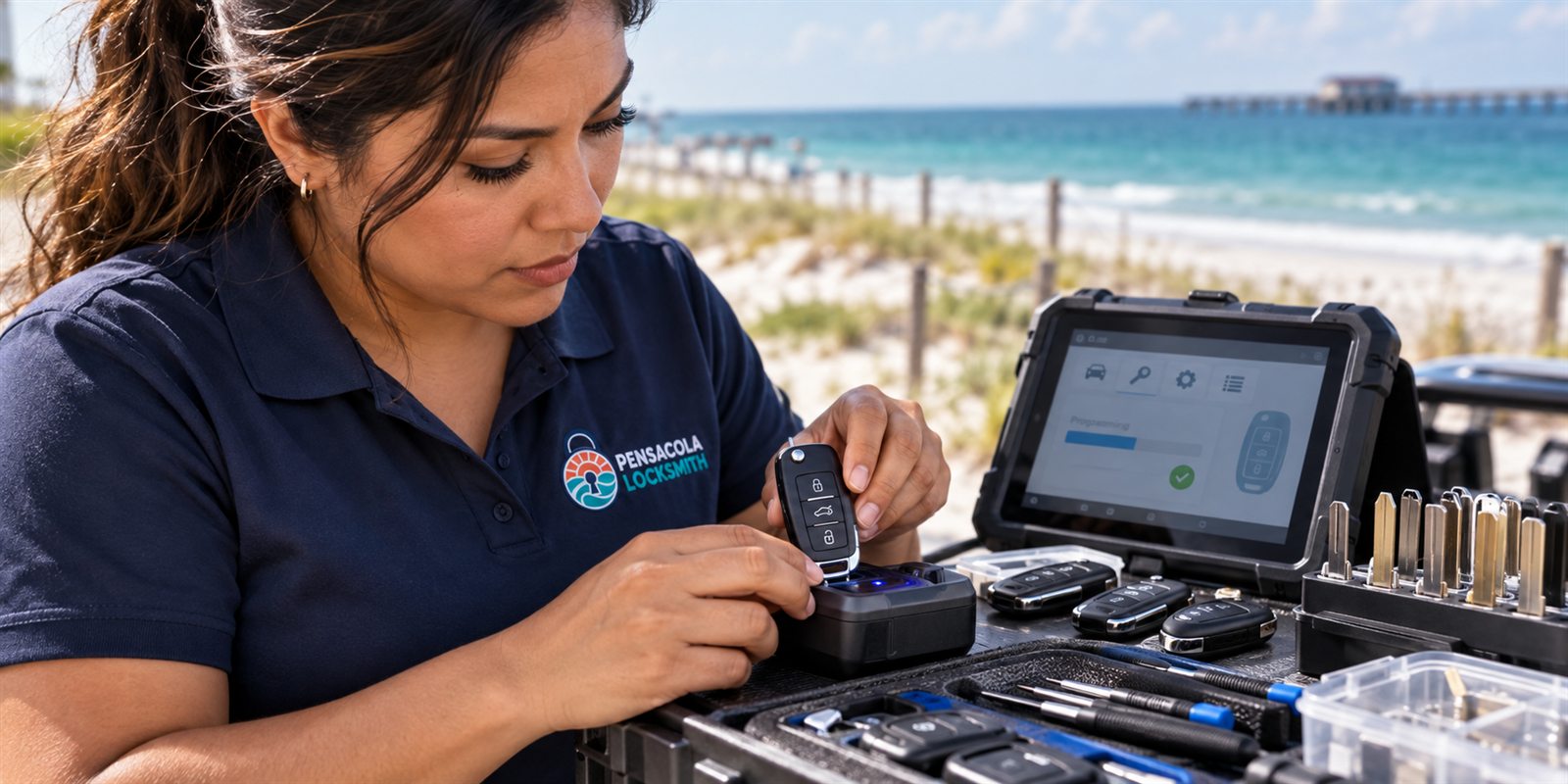
A proximity fob carries a small transmitter and a battery. When you pull a door handle or push the start button, the vehicle sends a short wake signal into the surrounding area. If the fob is within range, it answers with an encrypted message. The vehicle checks the message and, if it is valid, allows entry or engine start. The exchange happens in a fraction of a second and you never notice it.
Because the conversation is encrypted and unique to each fob, a new fob must be formally registered. A technician uses diagnostic equipment to add it to the list of fobs the vehicle trusts. That list has a limit, and sometimes older entries must be cleared to make room. This is a good moment to decide which of your existing fobs should remain on the list.
An advantage of this design is convenience. The disadvantage is that the fob has several more parts that can fail: the battery, the antenna, the case seals and the button contacts. If your fob is behaving oddly, ask the technician to test it before you buy anything. Sometimes a battery swap restores normal range, and sometimes the electronics are beyond saving.
- Chip key with remote buttons in the head
- Proximity fob with a hidden emergency blade
- Plain chip key with no remote
- Fob that works only at very short range
A realistic walkthrough of a typical service visit
Imagine you have lost your only fob after a day at the beach. You call, describe the vehicle and say it is parked at home. The person you speak to asks whether you have any other working key, and you say you do not. You are told that ownership must be confirmed, so you set out your identification and registration. A technician is arranged, and the quote is given by phone.
At the vehicle, the technician reads the identification number, confirms the key system, and prepares a replacement fob and an emergency blade. The blade is cut to the door lock pattern. Then the diagnostic tool is connected, and the vehicle is asked to learn the new fob. You may be asked to open a door, press a button or turn the vehicle on and off at certain points in the process.
Afterwards, the fob is tested at several distances from the vehicle to confirm it is detected on all sides and inside. The remote buttons are tested too. You are told how many fobs the vehicle recognizes and whether the lost one was removed. If the job turns out more complicated than expected, the technician stops and explains first, including the service call charge, before anything else is done.
What to have in your hand before the call
A short list saves time. Find the vehicle identification number on the plate visible through the windshield at the driver side, or on the label in the driver door frame. Photograph it so you do not misread a character. Then locate your registration or title, which shows the name tied to the vehicle, and your own identification. These three items cover almost every ownership check.
Next, collect whatever keys remain. Even a key that no longer works is helpful, because the blade can be read and the chip may be cloned or studied. A broken key is useful too, so keep the pieces. If the vehicle's start button does nothing when you press it, note what the dashboard shows, any message or warning light, because that clue helps the technician work out whether the fob is the cause.
Lastly, think about the setting. Is the vehicle in a garage, a lot, or at a curb? Can the technician park nearby? Is there shelter if it rains? You do not need to arrange anything special, but sharing these details lets the technician prepare. Call us to describe the situation, ask questions about the process, and confirm availability before anyone is sent.
When all fobs are gone
With every fob lost, the technician starts from the vehicle's computer rather than from an existing key. Equipment is connected, the immobilizer is addressed, and a new fob is introduced as the first trusted device. This takes more steps than simply adding a spare, and the time varies by system. It is a routine job for a trained technician, but it is rarely a five minute one.
A second consideration is security. If your fob was lost somewhere public, or if you are not sure whether it was stolen, you may want older fobs removed from memory so that nobody can use them. During an all keys lost job this is easy to include, because every fob you want to keep is enrolled together at the end. Fobs you do not enroll no longer work.
Finally, if the vehicle is locked, the technician will first open it. Modern door frames and weatherstripping are designed to be tight, and the wrong tool can bend a frame or tear a seal. The technician uses entry methods intended to avoid damage. If an alarm sounds, it is normally silenced once a valid fob is learned or the vehicle is unlocked from inside. Describe the situation by phone and we can plan.
Small repairs that are not key replacement
Sometimes the fob is fine and a small repair is all that is needed. A cracked shell can often be swapped for a fresh one while the electronics are moved over. A worn emergency blade can be recut. A battery that has leaked can be cleaned and replaced if the circuit board has not been damaged. These repairs can cost less effort than a full replacement.
On the other hand, some damage cannot be fixed. A fob that has been crushed, soaked in salt water or left in a hot vehicle until the board warped may be beyond saving. The technician will examine it and tell you honestly. There is no point replacing a battery if the board is corroded. In that case, a replacement fob and programming is the realistic path.
If the problem is intermittent, such as the fob working in the morning but not in the afternoon, bring that up. Heat and humidity can cause temporary faults. A technician can test the fob in different conditions and look for signs of moisture. Tell us what you notice and when it happens, since the pattern often points to the cause.
Keys in a coastal, military and student town
Pensacola has a lot of movement. Service members stationed at the naval air station may move on a schedule, students arrive and leave with the semesters, and visitors fill the beaches in summer. Vehicles change hands, and each time that happens, keys can go missing. If you buy a used Acura, ask how many keys exist and consider having old ones removed from memory.
Moves and trips also raise the chance of losing a fob. If you are about to travel or relocate, make a spare beforehand. It is far easier to program a spare while the first fob still works than to deal with a lost fob in a place you do not know. If you are leaving the area, a spare given to a trusted relative can help in an emergency.
The Gulf environment adds a physical challenge. Salt and moisture reach metal contacts and leave residue, and heat softens plastic. Keep fobs dry, avoid leaving them in a car through summer afternoons, and wipe them after beach trips. These habits extend the life of your fob and reduce the chance of an unexpected failure at a bad time.
Planning for the next key, before you need it
The best time to make a spare is now. A spare costs the least effort when you have a working fob, since the vehicle can be taught the new one while recognizing the old one. It also means you decide the timing, not the moment of a lost fob. Ask about including a spare during any visit for another reason, such as a battery replacement.
Think about how many keys you actually need. Two is a sensible baseline for most households. If several people drive the vehicle, a third may be useful. Remember that each fob enrolled is another item that can be lost, and the vehicle can only remember so many. A short conversation with the technician will tell you the practical limit for your system.
Keep a record of your keys. Note when each was made and where it is kept. Store the vehicle identification number in your phone and a printed copy at home. If you sell the vehicle, hand over every key and tell the buyer about each one. These small steps make future visits straightforward and reduce stress when something goes wrong.
Used vehicles, dealer trade-ins and unknown key histories
Buying a used Acura means inheriting a key history you cannot see. The previous owner may have made extra fobs, and you will not know who holds them. Some sellers hand over a single key and keep a spare without meaning anything by it. Before you rely on a used vehicle for daily travel, it is reasonable to ask how many keys the vehicle was sold with and whether older ones can be cleared out.
A technician can help by connecting to the vehicle and seeing how many keys are registered, on systems that allow that check. If more are enrolled than you hold, you can choose to reset the list and program only the fobs in your possession. That way any unaccounted fob stops working. It is a calm, practical step, and it takes place at the vehicle, usually in one visit.
Also check the condition of what you were given. A fob with a cracked case, a missing button cover or a weak signal often comes from an owner who stopped caring for it. A fresh battery, a new shell or a replacement fob may bring it back to normal. It is easier to address these things in the first weeks of ownership than when the vehicle refuses to start on a busy morning.
Finally, keep the paperwork straight. Because a locksmith confirms ownership before programming, you will need the title or registration in your own name. If the transfer has not been completed yet, tell us when you call. We can explain what is acceptable. Do not wait until the day you are locked out to find out the registration is still in someone else's name.
Common questions
Can an Acura proximity fob be programmed on site?
In most cases, yes. The technician comes to the vehicle, confirms ownership, identifies the system and uses diagnostic equipment to register the new fob. Some systems take longer than others. Call us with the vehicle details and we will explain what is involved and confirm availability for your location.
Do you need the original key to make a new one?
No. Having a working key makes the process simpler, but it is not required. If all keys are lost, the technician works directly with the vehicle's computer to enroll a new one. This is a longer job. Tell us on the phone whether you have any key at all so we can plan correctly.
Can the old lost fob be disabled?
Often yes. During programming, the technician can set the vehicle to recognize only the fobs you choose, so a missing one will no longer start the engine. This is a sensible step if the fob was lost in a public place. Ask about it when you call and we will explain how it works for your vehicle.
Why do you ask for proof that the vehicle is mine?
Because we check ownership or authority before opening, cutting a key or programming one. Keys control access to a valuable vehicle, so the check protects you and everyone else. Identification plus a registration or title is usually enough. If you act for someone else, tell us when you call.
What if the problem is not the key at all?
Then we will tell you. A vehicle may fail to start because of the battery, starter or a security fault unrelated to the key. A technician can usually tell by the dashboard lights and basic checks. If the job is complicated, a technician visits and the service call charge is explained before dispatch.