
Content note: this page was written by Claude (AI) for Pensacola Locksmith.
What is actually inside a key fob
A fob looks like a plain plastic shell, but it holds a small radio transmitter, a circuit board, a set of rubber or plastic buttons, a battery and, in many cases, a transponder chip and a hidden emergency blade. When you press a button, the board generates a coded signal and the radio sends it to a receiver in the car. The receiver checks the code, and if it matches, the doors unlock.
Most fobs use a rolling code. This means the code changes every time a button is pressed, following a sequence both the fob and the car know. The design prevents someone from recording a signal and replaying it later. It also explains why a fob can fall out of sync if its buttons are pressed many times while out of range of the car.
Because there are so many parts, problems can arise in several places. The battery can weaken, the contacts can corrode, the buttons can wear through their coating, the board can crack after a drop, and the pairing with the car can be lost. Pinpointing which of these is happening is the first and most useful step, and it is usually possible with a few simple tests.
Start with the battery, because it is the usual cause
The most common reason a fob fails is a weak coin cell battery. The first sign is shorter range. You find yourself walking closer to the car before the doors respond. Next, you may need to press the button two or three times. Finally, nothing happens at all. Many fobs also show a dash message about a low key battery before they quit.
Replacing the battery is simple on many fobs, and it is worth trying before assuming anything worse. Open the case carefully, using a small flat tool in the slot or seam, and note which side of the old battery faces up. Match the number printed on the old cell. Press the new one in, close the case, and test the buttons near the car.
Be gentle with the case. Cracked shells, bent contacts and lost buttons are common outcomes of forcing it open. If the case will not open easily, or if the fob seems to be a sealed unit, stop and ask a technician. Also, avoid touching the flat faces of the new battery with oily fingers, because residue can weaken the contact.
When a new battery does not help
If a fresh battery brings no change, the next suspect is the pairing. A fob that has lost its connection with the car transmits perfectly well, but the car no longer recognizes the code. This can happen after a car battery was disconnected or replaced, after a repair that touched the body control module, or after the fob was pressed repeatedly out of range.
Another possibility is damage. A fob that has been dropped, soaked or left in the sun can have a cracked solder joint, a corroded contact or a failed transmitter. Signs include buttons that work sometimes, a fob that only works when pressed in a certain way, or visible green or white residue inside the case. Salt air accelerates this kind of corrosion.
A technician can test the fob with a handheld device that detects whether it is transmitting. If there is a signal, the problem is pairing, and reprogramming may fix it. If there is no signal, the board or transmitter has failed, and the choices are repair of the existing fob or replacement. Knowing which way to go saves money and avoids repeat visits.
How pairing a fob to a car actually works
Pairing teaches the car's receiver to accept the code sequence from a specific fob. Depending on the vehicle, this is done in one of several ways. Some cars allow a do-it-yourself sequence, such as turning the ignition on and off in a pattern and pressing a button on the fob. Others require a diagnostic tool connected to the data port.
The tool lets the technician put the car into a learning mode, where it will accept the next signals it hears. Each fob is then pressed, one at a time, and the car stores its identity. When the session is closed, the car holds the list of fobs it will accept. Any fob not on the list will not work.
This is why you cannot simply buy a fob and expect it to function. A blank fob needs to be matched in frequency and type and then added to the car's list. Used fobs from other vehicles may be locked to their original car. A technician checks compatibility before cutting, programming or spending your time on a fob that cannot be used.
The difference between remote pairing and engine start programming
People often use the word fob to mean two different jobs. The first is remote pairing: making the buttons lock, unlock, open the trunk and sound the panic alarm. The second is immobilizer programming: letting the key start the engine. On many vehicles these are handled separately, even though they live in the same piece of plastic.
This matters when something stops working. If your buttons fail but the car still starts, the problem is almost certainly on the remote side, and the immobilizer is fine. If the car will not start but the buttons work, the transponder side needs attention. A technician will check each function so they do not fix one and leave the other broken.
Smart fobs combine both functions into one encrypted conversation. The fob unlocks the doors when you approach and starts the engine at the button press. When one of these fails, the technician may need to reprogram the whole thing. Describe exactly what stopped working when you call, and it helps us choose the right tools.
Repair or replace: making a sensible decision
Repairing a fob makes sense when the fault is small and the fob is otherwise sound. Worn rubber pads can be replaced. A corroded battery contact can be cleaned or re-tinned. A cracked case can be swapped for a fresh shell while keeping the original board and chip. These repairs preserve the fob's electronic identity and avoid reprogramming the car.
Replacement is better when the board has failed, the case is badly damaged or the fob has been through water for long enough to corrode the components. A new fob is cut, paired and tested. If the original is too far gone, trying to save it only delays the fix, and a technician will say so rather than sell you a repair that will fail again.
Consider how much longer you plan to keep the car and how often you use the fob. A daily driver with a fob that fails repeatedly is a good candidate for replacement and a spare. A rarely used vehicle might be better served with a simple battery and a gentle reminder to keep the fob dry. The technician can help you weigh it.
Using the hidden emergency key while you wait
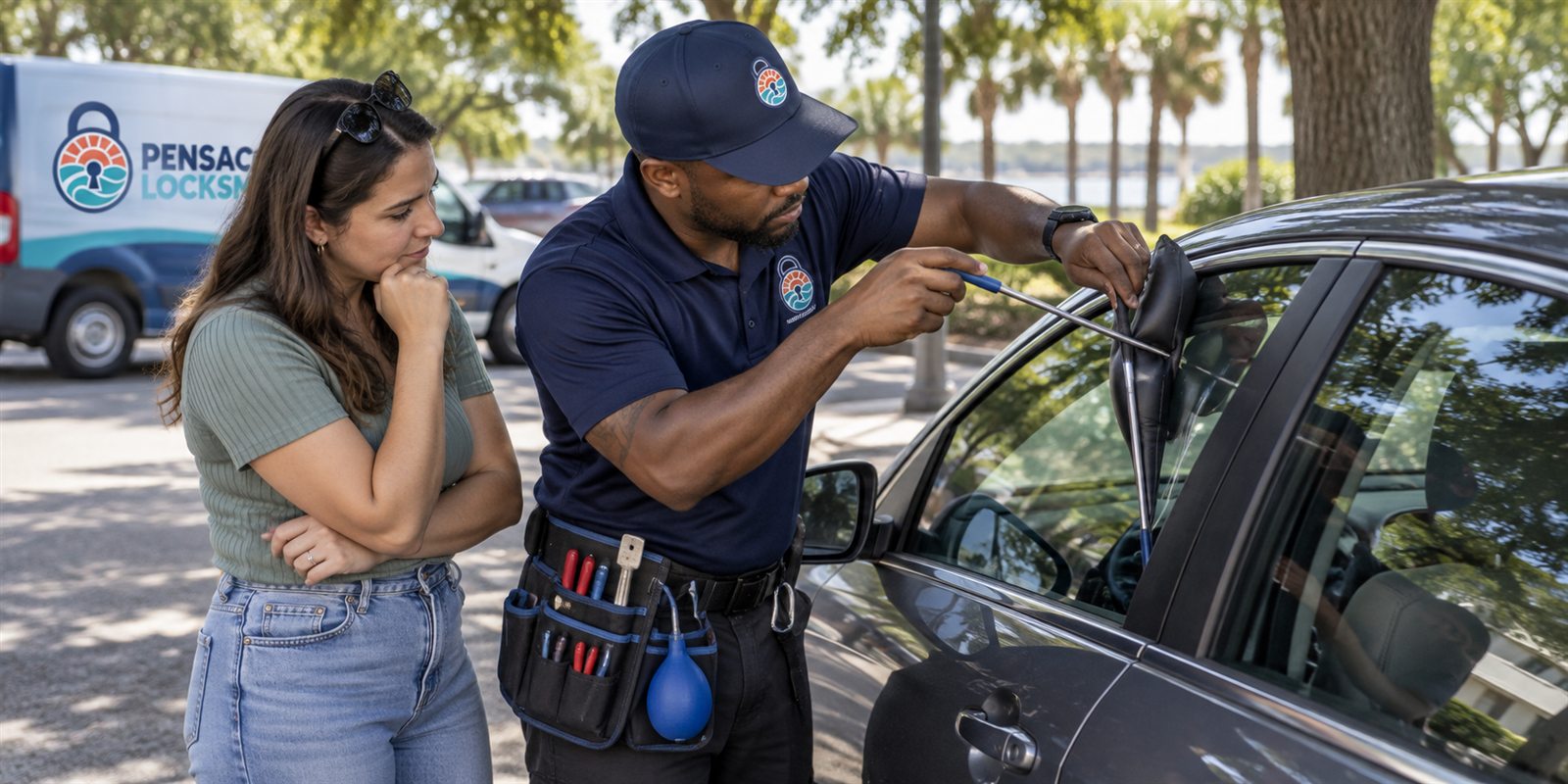
Nearly every smart fob contains a physical blade that slides out with a small release. Most owners never use it, and many do not know it exists. If your fob stops working, this blade can open the driver's door. On many cars, the lock cylinder is hidden under a small cap on the door handle, which pops off with the tip of the blade.
Once inside, starting the engine depends on the car. Many push-button vehicles let you hold the fob against the start button, or place it in a marked pocket, so that a short-range antenna can read the chip even if the battery is dead. Your owner's manual will show the spot. Try it before calling, because it may get you home safely.
Be aware that opening the door with the blade may set off the alarm on some cars. This is normal. Starting the engine with the fob in the backup position typically quiets it. If the alarm keeps sounding, a technician can help. Never force the lock if the blade will not turn, as that is how cylinders are damaged.
What happens during a fob programming visit
The technician arrives, confirms the vehicle and checks your ownership or authority over it. They look at the existing fob, test it for a signal, and examine the case, board and battery. If the fob is usable, they connect a diagnostic tool and put the car in learning mode. You may be asked to sit in the driver's seat and press buttons when told.
If you need a new fob, the technician brings compatible parts and checks that the frequency and type match. The fob is paired, and every function is tested in turn: lock, unlock, trunk, panic and any remote start button. If the car also needs a chip registered for starting, that happens next, followed by a test.
At the end, you should leave knowing how many fobs the car now recognizes, whether old ones have been removed, and how to replace the battery yourself. Ask for a quick demonstration if you are unsure. A clear explanation costs nothing and prevents confusion the next time a button acts up in a parking lot.
Ownership checks and why they apply to remotes
A fob is a way into the vehicle and, with the right chip, a way to drive it. For that reason, the locksmith confirms that you own the car or have the owner's permission before pairing a new one. A photo ID matching the registration, along with the plate or VIN, is the normal standard.
This applies even for a simple remote pairing, because a fob can be used to unlock a car from a distance. If a technician pairs a remote for someone who does not own the vehicle, they may be helping with theft. Taking a minute for the check is part of doing the work responsibly.
If the vehicle belongs to a company, a lender or a family member, tell us on the call. A short message from the owner, or paperwork showing your authority, solves the problem. Having it ready before the technician arrives lets the work start right away, and it keeps the process fair to the person who actually owns the car.
Protecting a fob in a humid, salty climate
Living near the Gulf means moisture is a constant. Fobs live in pockets, beach bags and cup holders, and humidity creeps in through the seams. Over months, a thin film can form on the board and contacts. Wiping the fob with a dry cloth, keeping it out of wet swimwear and storing it at home in a dry spot all help.
If your fob gets wet, act quickly. Remove the battery, open the case if you can, and let everything dry in open air for a day. Do not bake it in an oven or blast it with a hair dryer. A little isopropyl alcohol on a cotton swab can clean light residue, but only when the battery is out.
A silicone or hard case can protect the fob from drops, though it adds bulk. Avoid hanging the fob on a heavy ring with many other keys, since the weight and vibration wear the buttons and the case. Replace the battery on a schedule, perhaps every two years, so it never fails at the worst moment.
When more than one fob stops working at once
If every fob you own fails at the same time, the cause is probably in the car and not in the fobs. A weak car battery, a blown fuse, a faulty receiver or a glitch in the body control module can all cause this. In that case, buying new fobs or batteries will not help, and the technician will want to diagnose the car first.
A useful test is to try the physical key in the door and the ignition. If those work normally, the mechanical side is fine. Next, see whether the dash shows any warning about the key system. A message such as key not detected points to the receiver or antenna. A technician can read the fault codes and tell whether the problem is electrical.
Sometimes a recent event explains it, such as a jump start, a battery replacement or a visit to a repair shop. Share what happened before the failure, since it shortens the diagnosis. Call us to confirm availability, and we will advise whether a visit is likely to solve the problem or whether the car needs a mechanic first.
Aftermarket remote starters and add-on alarms
Some vehicles carry a remote starter or an alarm that was added after the car left the factory. These systems have their own remotes, and their programming is separate from the factory fob. When one of these remotes stops working, the problem may involve the add-on module and not the car, and the technician needs to know that an aftermarket system exists.
Look for clues such as a second small remote on your key ring, a blinking light on the dashboard that is not part of the original design, or a sticker in a window. If you bought the car used, you may not know what was installed. Mention anything unusual, because it changes how the technician approaches the job.
Add-on systems sometimes interfere with the factory immobilizer, so a key can behave strangely when the module misbehaves. In those cases, the best path may be a visit with the installer of that module. A good locksmith will tell you honestly when the issue is outside what can be solved with a fob, instead of replacing parts that were never at fault.
Common questions
How do I know if my fob needs a battery or programming?
Weak range, needing several presses and a low key battery message all point to the battery, so try that first. If a new battery changes nothing, the fob may have lost pairing or may be damaged. A technician can test whether the fob still transmits a signal, which tells you which one it is.
Can any fob be programmed to my car?
Only a fob that matches your vehicle's frequency and type, and that is not locked to another car. Many online fobs are the wrong type or cannot be reused. Call us before buying, describe the vehicle and the fob, and we will tell you whether it is likely to work.
Will reprogramming erase my other remotes?
On some vehicles, entering learning mode clears the old list, so every fob must be paired in the same session. On others, new fobs are simply added. The technician explains which applies to your car and asks you to bring all your fobs, so none is left out by accident.
Do you need proof that I own the vehicle?
Yes. Because a fob can unlock a vehicle, the locksmith checks that you own the car or have the owner's permission before pairing it. A photo ID that matches the registration, plus the plate or VIN on the car, is the normal standard. We tell you what to have ready when you call.
What if the fob is damaged or waterlogged?
The technician tests whether it still transmits. If the board is intact, it may be cleaned or moved to a new shell. If it has failed, a replacement fob is paired to the car. Quotes are given by phone, and if the job is complicated the service call charge is explained before dispatch.