
Content note: this page was written by Claude (AI) for Pensacola Locksmith.
What a lockout really is, and why it happens so often
A vehicle lockout simply means you cannot get into a car that you are entitled to drive. The reasons vary more than people expect. Keys get left on a seat while someone steps out to pump gas. A fob drops into a bag that gets closed in the trunk. A child presses the lock button on a remote and the door shuts. A key battery dies and the car stops recognizing it. Each of these looks the same from the sidewalk, but the fix can differ.
Pensacola adds its own versions of the problem. Trips to the beach mean keys wrapped in a towel, left in a cooler bag, or set on a bumper while hands are full of chairs and umbrellas. Salt air and humidity also wear on door lock cylinders and remote buttons over time, so a lock that once turned easily can start to stick right when you need it.
Knowing the cause helps the technician choose the gentlest approach. If the key is visible inside the cabin, the job is usually about reaching it or triggering the latch. If the key is truly lost, the job turns into key replacement, which is a different service. A short phone conversation sorts out which situation you are in before anyone drives out to you.
What to tell us when you call
The more precisely you describe the situation, the better prepared the technician can be. We will ask for the make and general type of the vehicle, the color, and where it is parked. We will ask whether the keys are visible inside, whether the engine is running, whether anyone or any pet is inside, and whether the trunk or another door might be unlocked. These questions are not stalling. They decide which tools go in the van.
Please tell us honestly if the car is not in your name. A vehicle that belongs to a family member, an employer or a rental arrangement can still be opened, but the technician needs to know who has authority over it. Having the registration, a rental agreement or a message from the owner ready saves time at the car door.
Quotes are given by phone once we understand the job. A simple lockout is straightforward to quote. If the car has an unusual door design, an aftermarket alarm, or a situation that needs more than a quick entry, a technician will visit and the service call charge is explained before dispatch, so you know where you stand before work begins.
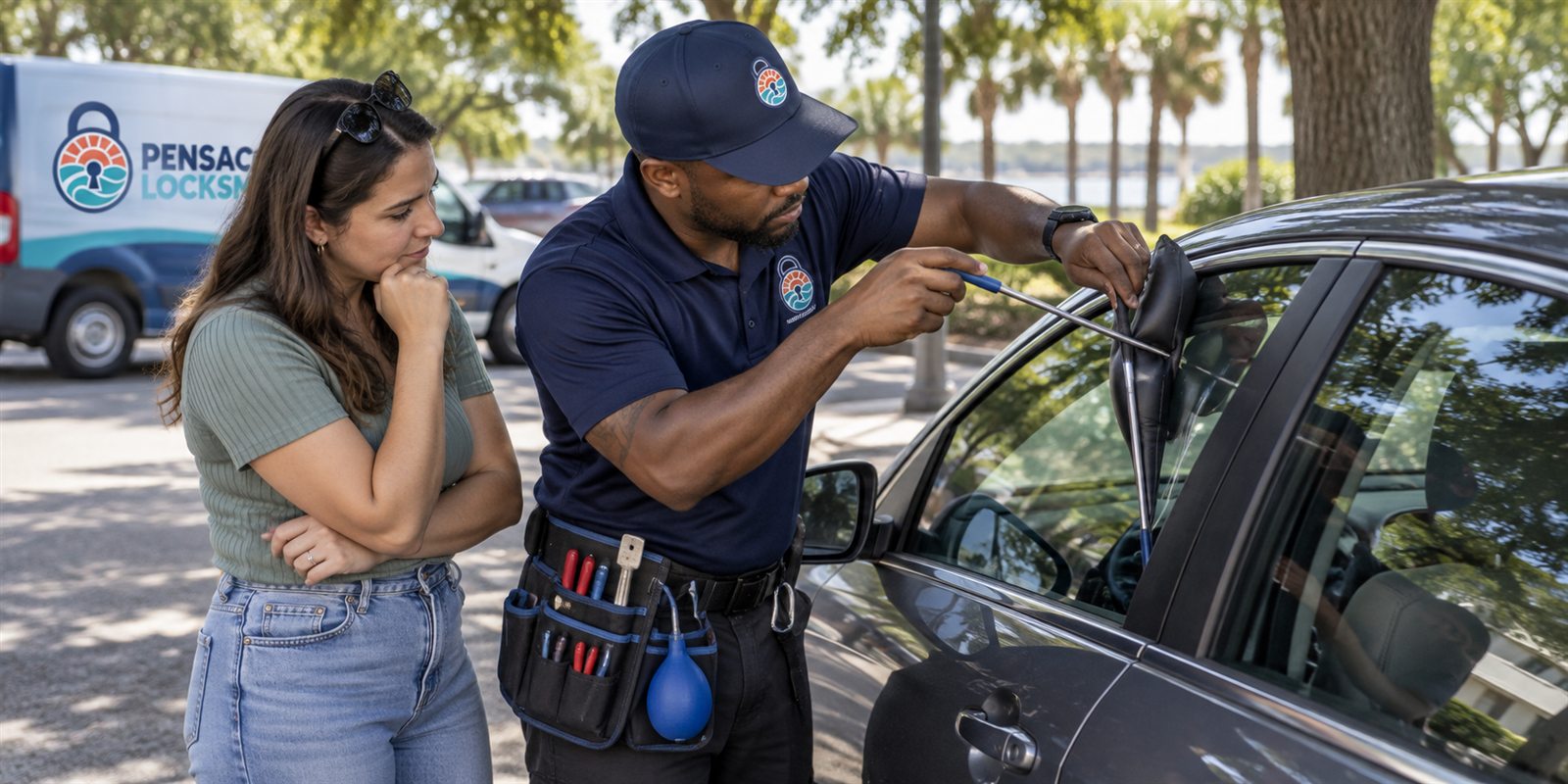
Ownership and authority checks before the door opens
A responsible locksmith does not open a car for whoever stands next to it and says it is theirs. Before entry, the technician checks that you own the vehicle or have the owner's permission. Typically that means a driver's license that matches the registration, or a registration or title that matches the person asking, along with the plate or VIN on the car itself.
This step can feel awkward when you are tired and annoyed, but it protects you. The same rule that makes a technician ask you for proof is the rule that stops a stranger from opening your car in a parking lot. If you are standing there with a valid license and the paperwork is in the glove box you cannot reach, there are other ways to show it, such as the registration saved in your phone or an insurance card app.
If someone else owns the car, a call or message from the owner, plus your own identification, often covers it. Rental and fleet vehicles may require the technician to contact the company. We will tell you what is needed on the phone so there are no surprises when the technician arrives, and so you can gather it while you wait.
How entry is done without damaging the car
Modern doors are tightly built. Weather seals, side airbag wiring, window regulators and rod linkages all sit inside the panel. A technician's goal is to reach the interior latch or unlock button without bending the door frame, scratching paint or disturbing anything in that tight space. That is why professional entry uses purpose-made tools rather than a coat hanger or a slim strip of metal from a hardware drawer.
The usual method places a thin protective wedge at the top corner of the door to make a very small working gap, and then an insertion tool reaches through to the lock control, the door handle or the unlock switch. The wedge is soft and is seated slowly, because pushing too hard or too far can warp the frame or leave a permanent wind noise at highway speed.
Some cars suit a different approach, and some rear doors or older vehicles can be opened through the lock cylinder itself with a pick or a decoder. A technician reads the car first and then picks the method with the lowest risk. If a method will not be safe for the vehicle, a good technician says so, rather than forcing it.
What the technician checks first when arriving
Before any tool touches the car, the technician walks around it. They look for an unlocked door you missed, a cracked window, a trunk release, or a key hidden in the wheel well that was left there on purpose. A quick check like this sometimes solves the problem with no tools at all, and it also reveals any existing damage so everyone agrees on the vehicle's condition before work begins.
Next comes the question of what is inside. If a pet or a child is in a hot car, the situation is an emergency and the right move is to call emergency services immediately, because those responders can act in seconds. A technician will always tell you that. With the Gulf Coast heat and humidity, a closed car warms up very quickly, even on a day that does not feel especially hot.
Then the technician looks at the door type, the lock design, any visible aftermarket alarm or immobilizer lights, and whether the car is running. A running car with the keys inside requires extra care, since opening a door can trigger an alarm or, in some cases, relock the vehicle. Knowing this in advance prevents a second lockout moments after the first one is solved.
When the problem is bigger than a locked door
Sometimes the lockout is a symptom. If the door will not unlock from the remote and the key turns but does nothing, the lock actuator inside the door may have failed. If the key will not turn at all, the cylinder could be worn or gummed with corrosion from salty coastal air. In those cases, getting in is only the first step, and the technician will explain what the next step looks like.
A dead key fob battery is another common surprise. The car locks fine, but the remote no longer responds, and the hidden mechanical key inside the fob is a spare most owners have never used. Many people do not realize their fob has one. If you are stuck, try releasing the emergency key from the fob and using the small keyhole that is often hidden under a cap on the driver's door handle.
If the keys are not inside and are simply gone, the job changes to making a new key. That involves confirming ownership, reading the vehicle information, cutting the key and programming it. We cover those services on separate pages, and we can explain the options on the same call so you do not have to start over with another provider.
Things you can do while you wait
First, move yourself to a safe place. Parking lots at busy shopping areas, boat ramps and beach lots have heavy traffic and distracted drivers. If you are in a spot with no shade, find some, and keep water with you. Pensacola summers are hot and humid, and waiting beside a sun-baked car can be uncomfortable or unsafe for anyone with health concerns.
Second, gather proof of ownership. Look for photos of the registration on your phone, your insurance card, your driver's license, and any email from the dealer or lender. Have the plate number and, if you know it, the VIN, which is visible through the windshield at the lower driver's side corner. Having these ready means the technician can begin work right away.
Third, resist the urge to try your own entry. Shoving a wedge, a ruler or a wire into a door can scratch paint, tear a seal or knock a wiring harness out of place, and that can cost more than the lockout ever would. If you have a spare key at home and someone can bring it, that may be the simplest answer, so mention it on the phone.
Special situations: running engines, alarms and hot cars
A car left running with the keys inside is a common lockout. The main risk is that the door lock might reset when the door opens, or that the alarm may sound once entry is made. A technician will approach it slowly, open the door only once the unlock control has been reached, and then help you shut the engine off and secure the vehicle.
Cars with factory or aftermarket alarms may chirp, flash and sound when a door opens without the recognized key. This is normal and does not mean the technician did anything wrong. Once the correct key is in hand and the ignition is switched on, most systems quiet down. If an alarm continues, the technician can help you work out whether the system has a reset step.
Some vehicles lock themselves when the key is out of range or when a timer expires, which can strand you after you thought you had solved the problem. Being aware of this behavior and keeping a spare key in a safe place makes a repeat lockout much less likely. Ask the technician about the model you drive if you are unsure.
Preventing the next lockout
A spare key is the simplest protection against a repeat, and it works best when it is kept somewhere other than the car. A trusted family member's home, a work desk or a secure lockbox at home are all reasonable. Avoid hiding a key on the vehicle itself in a magnetic box under the bumper, because those are well known and can be lost on the road.
If your key has a transponder chip or a remote, make sure the spare is actually programmed and not just a blank cut copy. A copy that opens the door but will not start the engine only solves half of the problem. Test the spare by starting the car with it before putting it away. We can check this during a visit.
Habits matter too. Picking one spot for keys at home, attaching a loud keychain, and doing a quick pat-down before closing a door add up to far fewer lockouts. For households with young drivers or several people sharing a vehicle, agreeing on where the keys live is worth the minute it takes. If you need a spare made, call us and we will explain the process.
Lockouts around the Pensacola area
Pensacola is a mix of residential neighborhoods, busy shopping corridors, downtown streets, university grounds and beach access lots, and each setting changes the practical side of a lockout. In a narrow downtown space the technician may need to work with traffic close by, and in a beach lot the car may be hot, sandy and surrounded by people leaving for the day. We plan around where you actually are.
Military families near the naval air station sometimes face lockouts on base-adjacent roads or in shared parking, and visitors with rental vehicles often have unfamiliar key designs. Students at the local university and college may be driving a family car and need a way to prove authority. In every case the same ownership steps apply, and we explain them before the technician comes.
Weather plays a role as well. During hurricane season, traffic, evacuation and storm preparation can fill roads and parking areas, and a lockout at the wrong moment is more than a nuisance. Call us to confirm availability, tell us where you are, and we will help you work out the safest place to wait and the quickest sensible way to get moving again.
Aftercare: checking the car once you are inside
Once the door is open, a good technician does not just hand you the handle and leave. They will check that the door still closes and seals properly, that the lock and window work, and that no warning light has appeared on the dash. They will also walk you through anything that looks different, so you can be sure the car is in the same condition as before.
This is also the moment to look at the key itself. If the mechanical key feels worn, if the fob buttons stick, or if the remote works only when held at the windshield, those are signs a replacement or a battery change is coming. Fixing it now, while a technician is already there, avoids another lockout on a day that is already difficult.
Finally, think about whether this lockout points to a habit worth changing. A key with no spare, a fob that never gets a new battery, or a lock cylinder that has been sticking for months are all things a technician can address. Ask questions before the technician leaves, and we will explain the options without any pressure.
Common questions
Will opening my car damage the paint or door?
A technician uses purpose-made tools, protective wedges and slow, controlled movement to avoid contact with paint, seals and wiring inside the door. The aim is to reach the unlock control without leaving any mark. If a method would put the vehicle at risk, the technician will tell you and choose a safer one, even if it takes a little longer.
What do I need to show before you open the car?
You will need to show that you own the vehicle or have the owner's permission. Usually that means a valid photo ID that matches the registration or title, plus the plate or VIN on the car. If the car belongs to someone else, a message or call from the owner helps. We explain what is needed when you call.
Can you open a car with a child or pet inside?
If a child or animal is locked in a car, call emergency services first. They can respond immediately and are equipped for that situation. After you have called them, you can also contact us, and we will do what we can. Never wait for a locksmith when a life may be at risk, especially in Gulf Coast heat.
How much does a car lockout cost?
Quotes are given by phone after we understand the vehicle and situation. A simple lockout is quoted plainly. If the job looks complicated, a technician visits and the service call charge is explained before dispatch, so you know what to expect before any work starts. Call us to confirm availability and get your quote.
My keys are not in the car, they are lost. Can you still help?
Yes, but it becomes a key replacement job rather than a simple lockout. The technician confirms ownership, reads the vehicle information, cuts a new key and programs it to the car. We can explain that process on the phone so you know the steps and what information to have ready before the technician arrives.