
Content note: this page was written by Claude (AI) for Pensacola Locksmith.
Why safes stop opening
Safes fail for ordinary reasons more often than dramatic ones. A forgotten combination is the most common. Next come dead batteries in an electronic keypad, a lost key for a keyed safe, and a bolt that has jammed because the door was slammed or the contents shifted. Each calls for a different approach, and the first job is working out which one you have.
Time and conditions play a part too. Coastal humidity can corrode a mechanical dial or the contacts in an electronic lock. A safe in a garage or closet near the water may have rust inside that the owner never sees. Electronic keypads can also develop worn buttons, so a code that used to work becomes unreliable.
Sometimes the safe was never set up the way the owner remembers. A previous resident may have changed the code, or a family member may have used a different method. When you call, tell us what happened just before it stopped working, because even a small detail can point toward the right fix.
Types of safes and how their locks differ
Mechanical dial safes use a rotating dial and a set of wheels inside the lock. A person who knows the combination turns the dial to line up gates so the bolt can retract. These locks need no power and can last for decades, but they are sensitive to wear and misalignment.
Electronic keypad safes use a circuit board and a small motor or solenoid. They are quick to use, and the code can often be changed easily. They depend on batteries and sometimes have an override key. Failures tend to come from low batteries, a worn board, or a motor that no longer pulls the bolt.
Keyed safes, like many small home or hotel style units, use a regular cylinder. Some have a biometric reader as well. Gun safes, fire safes and wall or floor safes each have their own construction. The type, size and rating matter, because the method for opening a thin box is very different from the method for a thick, heavy one.
Proof of ownership and why we ask
A safe holds valuables, which is exactly why we do not open one for anyone who asks. Before work begins, we check that you own the safe or have authority over it. That may mean showing identification that matches the address, and in some cases a document that links you to the property or the safe. We may ask about the contents in general terms.
If the safe belongs to someone who has passed away, or to a business, the situation is a bit more involved. For an estate, paperwork showing your role may be needed. For a business, we want to hear from an owner or manager. For a rental unit, the landlord or tenant may each have a claim, and we sort out who controls the safe.
This is not meant to make life difficult. It protects you from the possibility that someone else could talk their way into your safe. If a request does not feel right, we may decline. The check usually takes just a few minutes of talking and looking at documents, and it keeps the process safe for everyone.
How a safe is actually opened
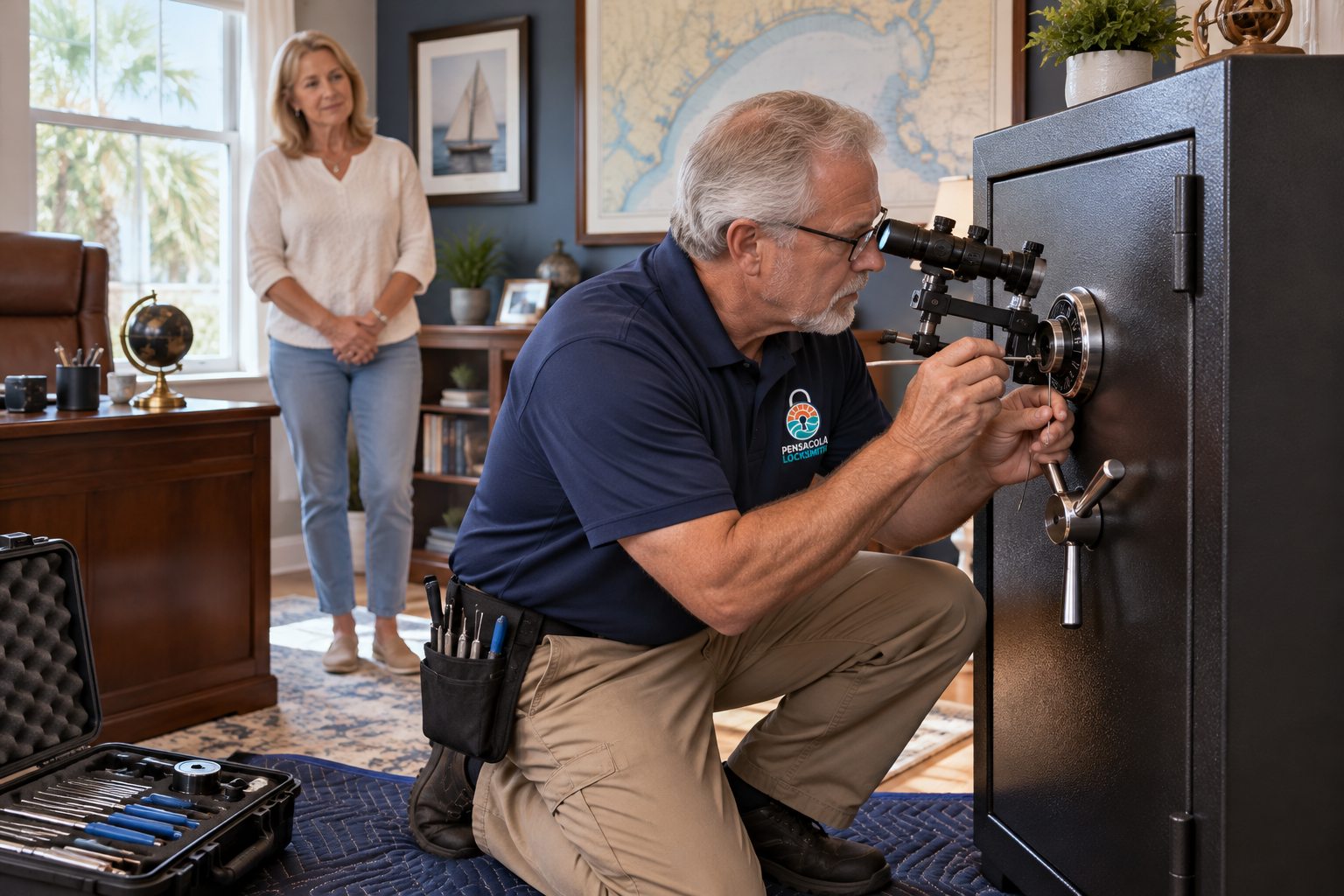
There is no single trick. A technician starts by understanding the lock type and what has failed. Where possible, the safe is opened non destructively. For a keypad safe with a dead battery, that may be as simple as external power. For a mechanical lock, a skilled technician may be able to manipulate the lock by feel and sound, which takes patience and practice.
When that does not work, drilling may be needed. Drilling is done at a carefully chosen point so the lock can be defeated and then, in many cases, repaired. A drilled hole does not automatically ruin a safe. The right spot depends on the lock model, and the technician knows what is behind the steel and where hardened plates may sit.
Some jobs are more brute force than precise, such as cutting into a safe whose lock mechanism has been destroyed. These are rare. We explain the likely path and what it could mean for the safe before starting, so you are not caught off guard by noise, dust or a damaged door.
Fixing, resetting and servicing after an opening
Getting the door open is half the job. Afterward, we look at why it failed. A worn lock may need replacing, a bolt that jams may need cleaning or adjusting, and an electronic board may need a new keypad. If we drilled, the lock can often be replaced or the hole sealed so the safe stays serviceable.
We can also reset the combination or change the code so the safe is ready to use. For a mechanical lock, a new combination may be set with the dial. For electronic locks, the new code can be programmed straight away. Choose something you will remember but others will not guess.
A safe is only as useful as its lock. If you want to keep using one that has failed once, we discuss whether to repair or replace. Sometimes the lock is simple and cheap to fix. Sometimes the safe is old and not worth the effort. We tell you honestly, and let you decide what makes sense.
What you can try before calling
For an electronic safe, start with the batteries. Fresh ones solve many problems. Use the type the manufacturer specifies and insert them the right way round. Many safes have an external battery box, or a way to power the keypad from outside. Check the manual or the underside of the keypad cover.
Try the code slowly and deliberately. A rushed entry can miss a button. If the keypad has lights or beeps, note what they do, since a pattern can indicate low battery or a lockout. Many electronic safes lock themselves for a time after wrong attempts, so waiting a few minutes may be needed before trying again.
Avoid forcing the door or hitting the safe. Pounding can shift internal parts and make a bad situation worse. If the safe has a backup key, look for it in the places you normally keep important items. If none of this works, stop and call. A calm description of the symptoms will help us plan.
Combination and code management
The most common cause of a locked out safe is a code that lived only in someone's memory. A safer approach is to record it somewhere separate from the safe. A sealed envelope held by a trusted person, or a note in a secure place that others do not know about, is better than a sticky note on the wall.
For households, think about who needs access. If the safe holds documents that a spouse or adult child might need in an emergency, share the code with them or leave instructions in a will or letter. Ask yourself what would happen if you were away or unable to speak.
Change codes when circumstances change. After a divorce, a move, a family dispute, or when an employee who knew the code leaves, a fresh code is sensible. A technician can help with this, and a good code avoids obvious patterns such as birthdays, repeated digits or a simple sequence.
Humidity, storms and protecting contents
The Gulf Coast climate is hard on safes. Humidity can rust the inside of a steel box, and papers or electronics can suffer. Many owners use a desiccant pack or a small dehumidifier rod inside, and check it regularly. Wrapping documents in sealed bags adds more protection. Fire ratings do not always mean water protection, so check what your safe is built for.
Hurricane season adds another concern. If a storm threatens, think about where the safe sits. A safe on a ground floor can be exposed to flood water. Moving it, or at least raising it, can help. A safe that is bolted down is harder to move quickly, so planning ahead matters.
After a flood or storm, do not assume a wet safe is safe to open by force. Electronic parts may be damaged, and mold may have formed inside. A technician can help open and dry the safe. Contents should be dried carefully, and any important documents are best handled gently and copied if possible.
Wall safes, floor safes and hidden units
Wall and floor safes are built into the structure of a building. They offer concealment, but they also bring special problems. A floor safe in concrete can collect water and rust. A wall safe behind a picture can be damaged by drywall work. Access may require clearing a space and removing items around it.
When opening these, the technician has to protect the surrounding surface as much as possible. Drilling into a wall safe is done with care so dust and debris are contained. A drop cloth or vacuum may be used. If the safe is in a rental or part of a historic home, extra care keeps the finish intact.
If you have found a safe in a home you recently bought, tell us. Unknown safes are a common situation. We follow the same ownership checks, and it may be necessary to confirm that the safe belongs to you as part of the property. In some cases, a closing document or contact with the previous owner may be useful.
Business safes and key holders
A business safe often holds cash, important papers or sensitive items. Several people may know the combination, and turnover can leave a trail of people who once had access. Changing the combination when staff leaves is a basic precaution. We can set a new code and explain the steps for doing it yourself later.
Drop safes and deposit safes have a slot for items to be placed inside without opening the safe. They are meant to limit access, and opening them often needs a manager's authority. We will ask who is allowed to approve, and if that person is not present, we may need to wait or reschedule.
For businesses, a log of who opened the safe and when can be helpful. Some electronic models keep an audit trail, while mechanical ones do not. We can talk through which type suits your level of need. The goal is a safe that is reliable, controlled, and not a single point of failure.
Getting a quote and what the visit looks like
Call us and describe the safe: brand if you know it, type of lock, approximate size and what happened. A photo of the label, if you can find one, can help with identifying the model. Do not send serial numbers, codes or personal details in writing. A voice conversation is enough to start.
Quotes are given by phone based on your description. If the job looks complicated, a technician visits and the service call charge is explained before dispatch. Some safes are heavy or in awkward places, and we plan accordingly. Please call to confirm availability.
At the visit, we confirm ownership, assess the safe, explain the options and then proceed. After opening, we help you decide whether to repair, reset or replace the lock. You leave with a safe that works and an idea of how to keep it that way, which is really the main goal.
Noise, time and mess: what to expect
People often picture a safe opening as quick and quiet. Sometimes it is, particularly when a keypad safe only needs fresh power or a code reset. Other jobs take real time and effort. Manipulating a mechanical lock can take patience, and drilling through hardened plate involves noise, vibration and fine metal shavings that need to be cleaned up afterward.
We tell you before we start what the process might involve, so you can plan around it. If the safe is in a room with carpet, a bedroom closet or a finished space, we protect the area and clear the immediate surroundings. If neighbors share a wall, as in an apartment or condo, the noise may be worth mentioning to them in advance.
Dust and metal particles are real, so we avoid working near open food, electronics or delicate items. It helps if you clear the area around the safe and keep children and pets away. After the work, we tidy the space and show you the result before we leave, so you can check everything is as expected.
When a safe should be replaced, not repaired
Not every safe deserves another round of repair. A thin metal box with a cheap lock may cost more to fix than to replace. A safe with deep rust, a warped door or a lock that has been drilled more than once may be at the end of its useful life. We give an honest view when we see one of these.
If you decide to replace, think about what the safe is protecting. Fire resistance, water resistance, burglary resistance and size are different features, and few safes do all of them well. A small fire box is useful for documents, while a heavy steel safe resists tampering. Tell us what you keep inside, and we can help narrow the choices.
Installation matters as much as the box. A safe that is bolted to the floor or wall is far harder to carry off than one that simply sits on the floor. Placement away from water and out of obvious sight also helps. We can talk through where to put it and how to anchor it, so the next one is both secure and easy to use.
Common questions
Will opening my safe damage it?
Not necessarily. Many safes can be opened without damage, especially electronic ones with dead batteries. When drilling is needed, it is done at a chosen point and the lock can often be repaired or replaced afterward. We explain the likely approach and any effect on the safe before starting.
What proof of ownership do you need?
We ask for identification that fits the address or the situation, and sometimes a document showing your connection to the property or business. For estates or rentals, we may ask for paperwork or contact with the right person. The check protects you and the contents of the safe.
I forgot my combination. Can it be recovered?
Sometimes a mechanical lock can be opened by manipulation, and sometimes the manufacturer has a procedure if you can show ownership. If not, drilling may be needed. Once open, we can set a new combination and help you plan a safe way to record it.
My electronic safe has a blinking light and will not open. What should I do?
Replace the batteries first, using the type the maker specifies, and enter the code slowly. A flashing pattern can mean low power or a temporary lockout after wrong tries. If that does not help, stop and call us. Forcing the door can make the problem worse.
How do I avoid being locked out again?
Store the code or a spare key in a separate secure place, tell a trusted person where to find it, and replace batteries on a schedule. Have the lock serviced if it feels rough. A short check once a year catches most problems before they leave you stuck.