
Content note: this page was written by Claude (AI) for Pensacola Locksmith.
What rekeying actually means
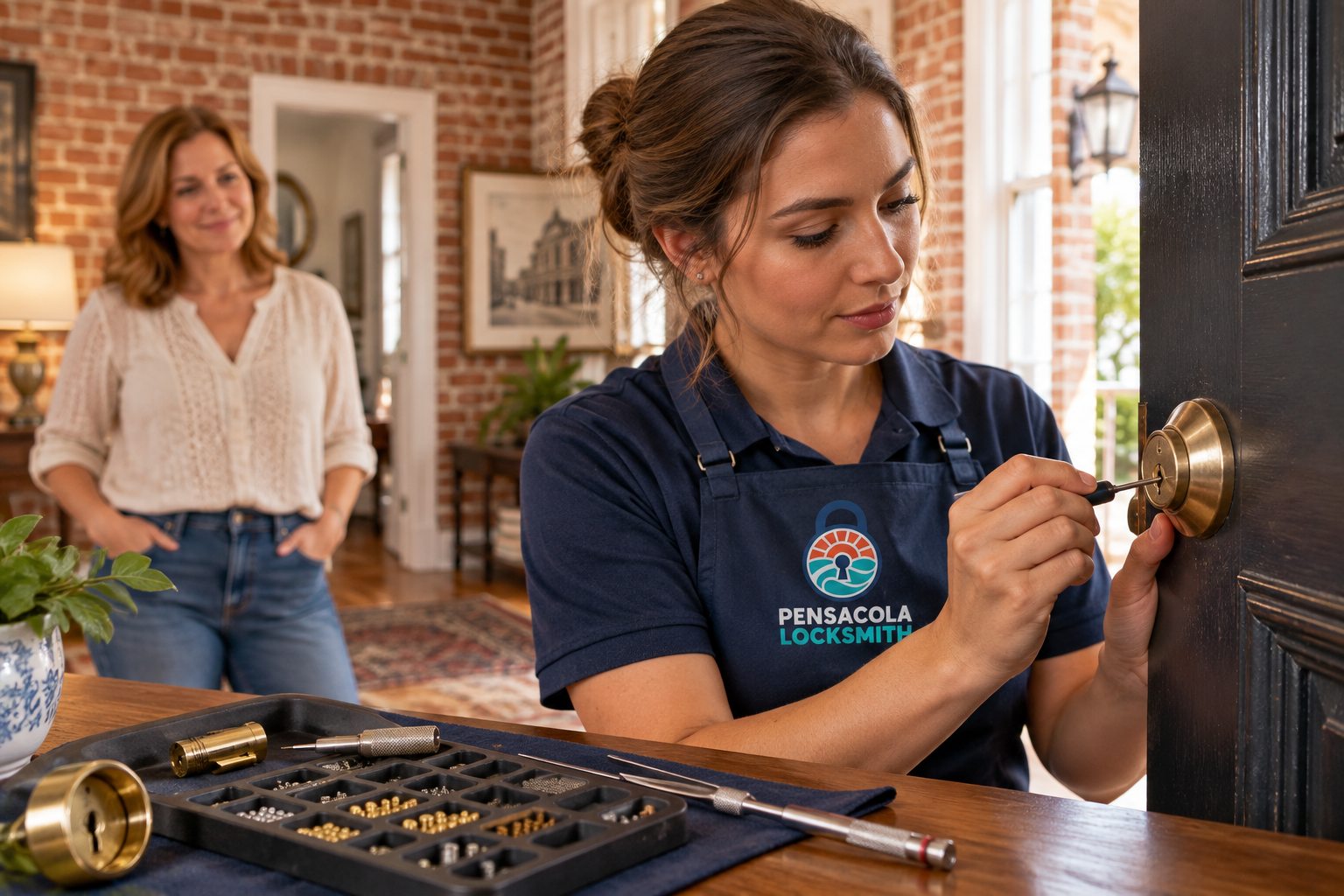
Rekeying changes the inside of a lock so that a different key operates it. Inside a standard pin tumbler cylinder, a stack of small pins of various heights sits in each chamber. The old key lifts each stack to the right height so the plug can turn. To rekey, a technician removes the cylinder, replaces the pins with a different combination, and cuts a new key to match. The old key no longer works.
The lock itself stays in place. The bolt, the latch, the handle and the faceplate remain on the door, which means there is no new hole to drill and no change to the look of the door. That makes rekeying quick and tidy compared with removing and fitting new hardware. It also means you can often rekey several locks to share one key, which simplifies a key ring.
Rekeying works best when the lock is in good mechanical condition. It answers the question of who can open the lock, not whether the lock is strong or smooth. If the hardware is solid and the only concern is control of the keys, rekeying is often the neat answer. A technician confirms ownership or authority before rekeying, which protects the property owner.
What replacing a lock means
Replacement means removing the existing lock and installing a different one. It might be the same type with new internals, or a different model with higher security, a new style or electronic features. A replacement also gives you a new set of keys, which cut off old copies just like rekeying does.
The advantage of replacement is that you change the hardware itself. A worn latch, a loose handle, a sticking deadbolt or a damaged cylinder gets a fresh start. You can upgrade the grade of the lock, switch to a finish that resists coastal corrosion, or add a smart feature. If the door preparation fits, the installation can be simple.
Replacement also takes more care. The new lock must fit the existing holes, backset and door thickness, or the door must be modified. A mismatch can mean drilling, patching or replacing the strike plate. On older or historic doors, such changes may harm the door's character. For these reasons, replacement is a decision worth thinking about, not an automatic default.
When rekeying is the right answer
Rekey when the lock is sound but the keys are not under control. Classic cases include moving into a new home or apartment, when you cannot know how many copies of the old keys exist; ending a relationship or roommate arrangement; losing a set of keys; or having a contractor or employee leave with a key. In each case, the concern is who has access, and rekeying answers it directly.
Rekey also suits situations where you want convenience. If your front door, back door and garage entry all use different keys, a technician can rekey them to match, so you carry one key instead of three. For a business, a rekey can set up a hierarchy with a master key and individual keys. Ask about the options for your hardware.
Finally, rekeying is a good choice when the hardware matches your style and works smoothly. If the lock turns well, the finish is fine and the door is in good shape, there is no reason to remove it. Rekeying gets the benefit of new keys with less disruption. Expect the technician to test the lock after the work and to cut spare keys on request.
- You moved into a new home or rental
- Keys were lost, stolen or kept by someone who left
- You want several doors to share one key
- The lock works smoothly and looks fine
- You want to limit who holds working keys
When replacement is the better choice
Replace when the hardware itself is the problem. A lock that sticks, grinds or fails to throw its bolt fully may have worn internals that no new pins will fix. A cylinder with a bent plug, a broken spring or heavy corrosion is a candidate for replacement. Salt air and humidity can take their toll on older hardware, especially exterior locks facing the weather.
Replace when the lock is not strong enough for its job. A basic knob latch on an exterior door, a low-grade deadbolt, or a lock with a visible weakness is better upgraded than simply rekeyed. Replacement is also the path when you want a feature the old lock cannot offer, such as a keypad, a smart control or a restricted keyway that controls who can copy keys.
Replace when the finish is failing, the handle is loose or the lock is damaged by an attempted break-in. Tool marks, bent metal or a cracked body can hide structural weakness. After a break-in, a technician should inspect the door and frame too, since damage there affects any lock. Think of replacement as the choice when the old lock has reached the end of its useful life.
A short decision path
Ask yourself four questions in order. First, does the lock work smoothly in both directions with its current key? If it does not, the problem may be mechanical, and replacement or repair is likely. Second, is the lock strong enough for the door it protects? If you doubt it, replacement may be wise. Third, do you know and trust everyone who holds a key? If not, you need new keys, which either option provides.
Fourth, do you want something the old lock cannot give you, such as better corrosion resistance, a keypad or a different style? If so, replace. If the answer to all of these is that the lock is fine and you simply need new keys, rekey. Many people end up with a mix: rekey the good locks, replace the weak ones.
If you are still unsure, describe the situation to a technician. Mention the age of the lock, the brand if visible, how it feels in use, and why you are considering a change. A short phone conversation often settles the question. Quotes are given by phone. If the job is more complicated, a technician visits and the service call charge is explained before dispatch.
Signs a lock is worn out
Locks give warnings before they fail. A key that must be jiggled, turned with extra force or pulled back slightly to work suggests wear in the cylinder or in the key. A deadbolt that moves slowly or catches halfway may have a bent bolt or a misaligned strike. A handle that wobbles or a latch that does not retract cleanly points to a loose or worn mechanism.
Visible signs matter too. Look for rust, pitting or flaking on the faceplate and bolt. In Gulf Coast conditions, exterior locks can corrode from the inside out, so a lock that looks decent may be tired. Check the screws for looseness. If the lock moves when you push on it, the fasteners or the door around them may be failing.
If several of these signs appear, replacement is usually more sensible than rekeying a lock that is on its way out. It is wasteful to spend effort on new keys for a mechanism that may fail soon. Test the lock occasionally, and if it begins to show these symptoms, act before it traps you outside or inside.
Consider the whole opening, not just the lock
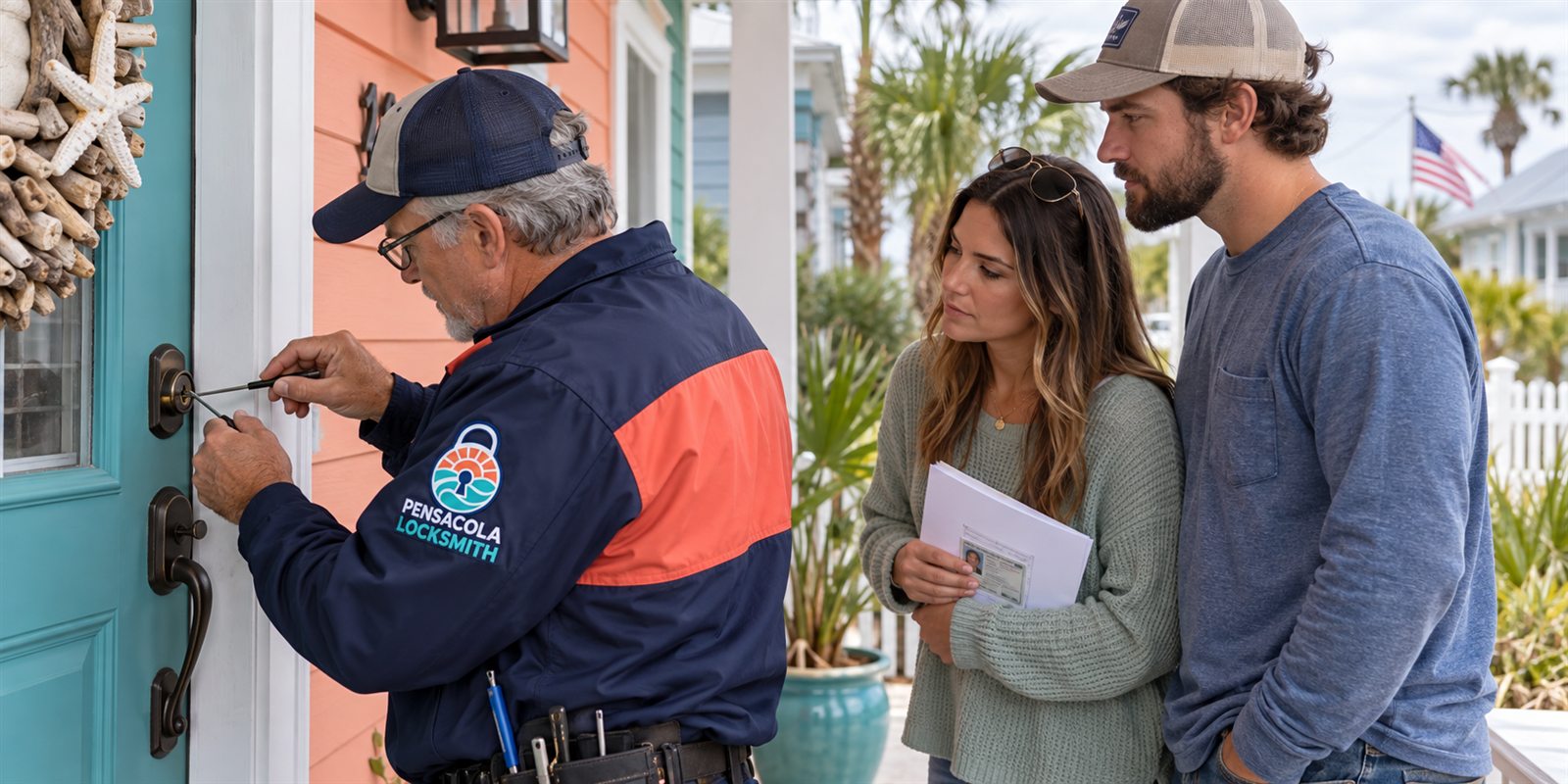
A lock sits in a door, and a door sits in a frame. Before you decide, look at the whole opening. Is the door solid, or hollow and dented? Does it fit the frame, or does it rub? Are the hinges sturdy with long screws? Is the strike plate firmly anchored? A new lock on a damaged door is a poor investment, and a rekeyed lock does not make a flimsy frame stronger.
Weather affects the opening too. Pensacola's humidity can swell wooden doors and frames, making locks bind in some seasons and rattle in others. Storms can loosen hardware. If a lock seems to stick only in damp weather, the problem may be the door, not the lock. A technician can adjust or repair the opening so any lock works properly.
Think about the larger picture of security. Lighting, visibility, window locks and habits matter as much as a single lock. If you are making changes after a break-in or a scare, have the technician look at the other doors and windows. A modest set of improvements, chosen carefully, often does more than a single expensive lock.
What the technician checks before and after the work
Before any change, a technician usually starts by examining the existing lock. They look at the brand, the keyway, the condition of the cylinder and how the bolt and latch move. They check the door edge and the frame for damage, and they test whether the key turns freely. This inspection tells them whether the lock can be rekeyed reliably or whether it is better replaced.
During a rekey, the technician removes the cylinder, takes out the old pins, installs new ones to match the new key and reassembles the lock. They test it repeatedly with the new key, and with the old key to confirm it no longer works. They check the latch and bolt for smooth movement and adjust the strike plate if needed. Small alignment fixes at this stage prevent callbacks later.
During a replacement, they remove the old hardware, check the door preparation, and fit the new lock, adjusting the backset and bolt as required. They test the lock with the door open and closed, confirm the bolt enters the frame fully, and show you how it operates. They hand over the keys and explain any special features. Ask questions until you feel comfortable.
Keys, copies and who holds them
The point of both options is to control access, so think about keys carefully. List everyone who holds a key now: family members, neighbors, former tenants, cleaners, contractors, relatives who house-sit. Not everyone on the list needs a key going forward. Decide who will receive new ones, and how you will keep track of them.
Think about copies. A restricted keyway limits where copies can be made, which is useful in a business or rental where you want to prevent casual duplication. For a home, it may be enough to make a small number of spares and store them securely. Avoid leaving a spare under a mat or in a flowerpot. If you want to share access, consider a keypad or a lockbox.
Keep a simple record. Note how many keys exist and who has them, and update the record when something changes. When someone returns a key, mark it. When a key goes missing, decide quickly whether a rekey is warranted. This habit costs minutes and can save you from the larger problem of not knowing who can open your door.
Timing, convenience and the cost of waiting
Some situations call for quick action and others allow time. If keys have been stolen, if you moved into a place with unknown key holders, or if a former partner still has access, act soon. A lock that others can open is not protecting you. If the only issue is that a lock feels stiff, you can plan a visit at a convenient time.
Waiting has risks, though. A worn lock can fail at the worst moment, leaving you locked out or unable to secure the door. A broken key stuck in a cylinder can complicate a simple job. During hurricane season or holiday periods, schedules fill up, so addressing lock problems before busy times is wise. Call us to confirm availability when you are ready.
Combining jobs can be efficient. If you are rekeying one door, consider whether other locks should be done at the same visit. If you are installing a deadbolt, ask whether the rest of the doors should share a key. A technician who is already on site can handle several tasks in one trip. Plan the list in advance so you make the most of the visit.
Special cases: rentals, businesses and cars
In rental properties, rekeying between tenants is a common practice because it is quick and keeps the same hardware. Landlords gain control without replacing locks each time. Tenants who want changes should check the lease and ask for permission. Whoever authorizes the work must have the right to do so, and a technician will confirm this before starting.
In a business, the choice depends on the system. A shop with a master key arrangement may rekey cylinders to maintain the hierarchy. A business that has lost a key or had an employee leave may rekey the affected doors. If the hardware is old or mismatched, replacing with commercial-grade locks and a consistent key system might be worth the effort.
Vehicles follow different rules. Car door and ignition locks can sometimes be rekeyed, and transponder keys must be programmed to the vehicle. Replacing a lock cylinder in a car often means a new key set and reprogramming. Ownership is checked before any vehicle work. Call us with the year, make and model, and we can explain what is possible.
What to do next
Once you have a leaning, take a few small steps. Gather any keys you still have, note the locks involved and decide how many doors you want to change. If you are rekeying, decide how many keys you want and whether doors should share a key. If you are replacing, think about the grade, finish and features you want.
Have your identification and a document showing you own or control the property, such as a lease, deed, mortgage statement or utility bill. This lets the technician confirm authority before opening, rekeying or replacing anything. For a business, bring paperwork showing your role. For a vehicle, bring the registration or title.
Then call us. Describe the situation and the locks. Quotes are given by phone, and if the job is complicated, a technician visits and the service call charge is explained before dispatch. Call us to confirm availability. We would rather help you choose the right fix than sell you a bigger job than you need.
Common questions
Does rekeying make my old keys useless?
Yes. Rekeying changes the pins inside the cylinder so that only the new key turns it. Old keys, including copies you do not know about, no longer work in that lock. The hardware stays on the door, so the process is usually quick and tidy compared with replacement.
When should I replace instead of rekey?
Replace when the lock itself is worn, damaged, corroded or too weak for the door, or when you want features the old lock cannot provide, such as a keypad or a better finish. Rekey when the hardware is sound and the only issue is who holds working keys.
Can several doors be rekeyed to use one key?
Often yes, if the locks are compatible. A technician can rekey the front door, back door and garage entry to match so you carry a single key. Compatibility depends on the brands and keyways. Describe your locks when you call and we can tell you what is likely.
Do I need to prove I own the property before a rekey?
Yes. The locksmith checks ownership or authority before rekeying or replacing locks on a home, business or vehicle. Bring a driver license plus a lease, deed, utility bill, registration or title, as fits your situation. This protects the true owner.
How do I get a quote for rekeying or replacing?
Call us with the number of locks, their type and your situation. Quotes are given by phone. If the job is complicated, a technician visits and the service call charge is explained before dispatch. Call us to confirm availability before you plan around a visit.