
Content note: this page was written by Claude (AI) for Pensacola Locksmith.
What an automotive locksmith does
An automotive locksmith works on the parts of a vehicle that control access and starting. That includes door locks, the trunk or hatch, ignition cylinders, keys and remote fobs, and the electronic systems that link them. The work is part mechanical and part electronic, and it requires tools and software that differ from home lock work.
Typical calls include a driver locked out, a key lost or broken, a fob that has stopped working, a key that will not turn in the ignition, or a car that will not recognize its key. Some people need a spare key made so they are not stuck again. Others need help after a theft or attempted theft.
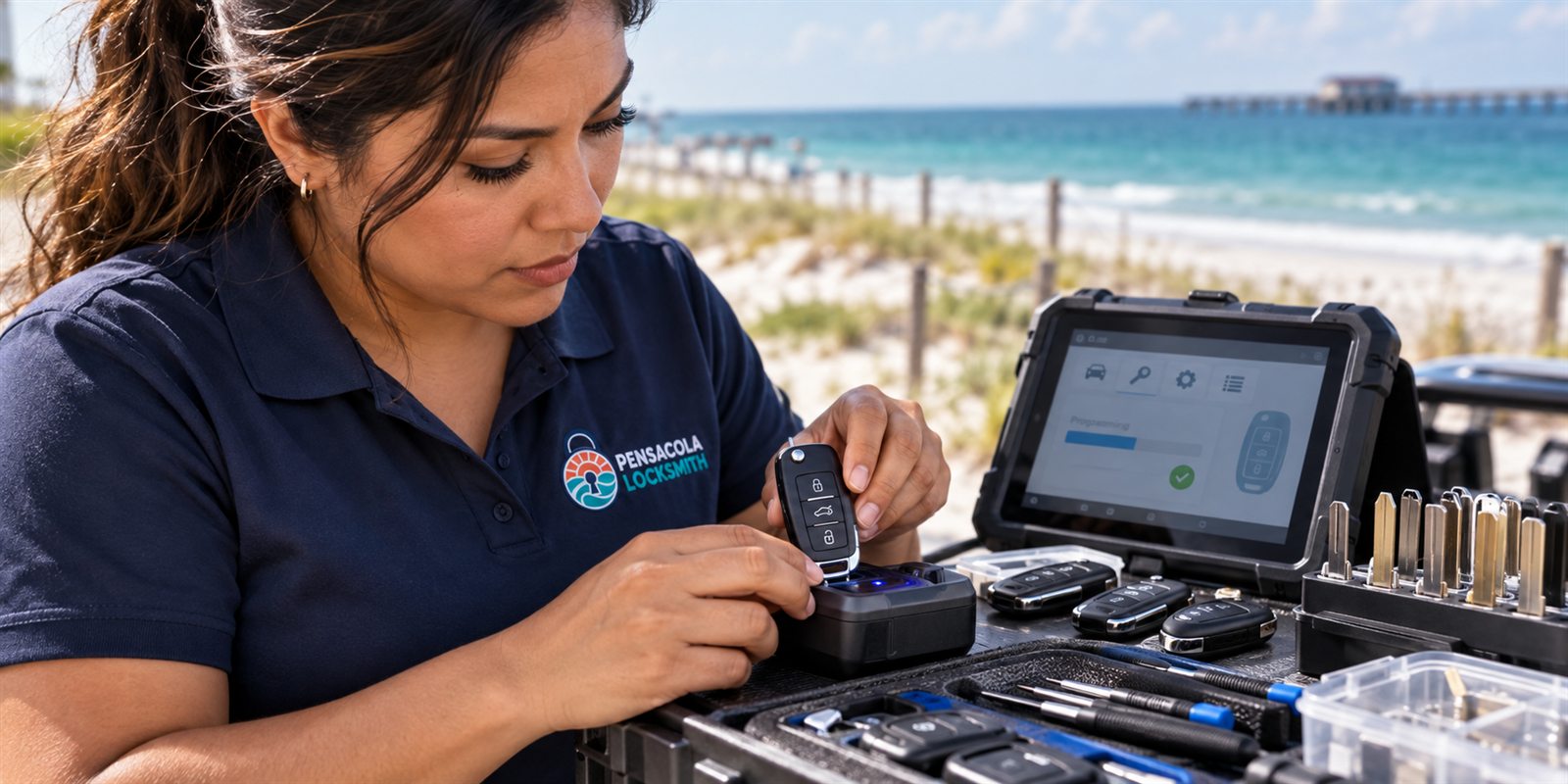
Working at the vehicle is a big advantage of mobile service. You do not need to tow the car or arrange a ride. The technician brings what is needed to your location, whether that is a driveway, a parking lot or a spot near the beach. We confirm that the job can be done there before we come.
Types of vehicle keys, in general terms
The simplest vehicle key is a plain metal key with no electronics. It cuts into the lock and turns the ignition mechanically. These are found on older vehicles and are easy to duplicate, though copies can still wear out and fail to turn smoothly.
The next type has a plastic or metal head with a small chip inside. The chip talks to the car, and the engine will not start unless the code matches. A copy cut only for the lock may open the door but not start the car. Programming is needed to teach the car to accept the new key.
Newer vehicles often use a remote fob or a proximity key. A remote fob has buttons to lock, unlock and open the trunk, with a hidden or attached blade. A proximity key allows the car to unlock and start when the key is near, often with a push button start. Each type has its own method of programming and its own limits.
Car lockouts: how they are handled
A lockout means the key is inside, the key is lost or the lock will not work. The technician first confirms ownership or authority, then checks the vehicle type and the situation. Where the cabin is locked with keys inside, the aim is to open the door without any damage to the paint, the seal or the lock.
Methods vary with the vehicle. Some doors can be opened through a small gap using soft wedges and long tools. Others need work on the lock cylinder. Modern vehicles often have side impact airbags and wiring in the door, so the technician avoids reaching into places where parts could be harmed.
If the key is lost, not just locked inside, opening the car solves only part of the problem. You still need a way to start it. The technician may offer to make and program a replacement key. We explain what that involves, what we need to verify and how long it is likely to take, so you can decide how to proceed.
Lost keys and all keys lost
A lost key is not the same as having no key at all. If you still have one working key, a copy is usually simpler. If you have lost every key, the process is different. The technician must create a key from scratch, and the vehicle must be taught to accept it. That takes more time and care.
To do this, the technician identifies the vehicle and its lock, cuts a key by code or by decoding the lock, and programs the chip or fob to the car. The method depends on the vehicle's security system. Some need a connection to the car's computer, while others can be done through the ignition.
We check ownership before this work. A key gives full control over a vehicle, so verifying you are the owner or authorized user is essential. A registration or title that matches your ID is the usual proof. If you do not have it with you, tell us. We will explain what else may work.
Key fobs and remotes
A key fob that stops working is often a battery problem. Replacing the small battery restores function in many cases. If that fails, the fob may need to be reprogrammed, or the case may have worn so contacts do not touch. A technician can test the fob and tell you what is wrong.
Fobs can also be damaged by water, drops or time. A cracked case or dead circuit board may require replacement. A new fob must be matched to the vehicle, which usually means programming. Some systems allow this with the existing keys, and others require special equipment.
Having a spare fob is wise. If you lose your only fob, the cost and effort of replacement go up compared to adding a second one while you still have the first. Think about keeping a spare at home, not in the vehicle. We can discuss how to add one and what the process looks like.
Ignition problems and broken keys
An ignition that is hard to turn, a key that sticks or a key that snaps off inside all point to wear. The cylinder has pins or wafers that move as the key goes in. Over time, they wear, and a key worn to match them can fail. Dirt and moisture make it worse.
If a key breaks in the ignition or a door lock, the technician removes the piece with small extractors. The aim is to avoid damaging the cylinder. After that, a new key is cut. If the cylinder is worn, it may be repaired or replaced, and the new key is matched to the vehicle.
Jiggling a key and forcing it to turn is a common habit that makes things worse. If your key needs help to turn, call before it fails. A technician can examine the ignition, advise whether it can be serviced and prevent a no start situation. It is much easier to fix a stiff lock than a broken one.
Trunks, hatches and glove boxes
Trunk and hatch problems often involve a latch, a release cable or an electronic switch. Some vehicles have a key cylinder on the lid, while others rely on buttons. If keys are locked in the trunk, there may be a way in through the rear seat or through a small gap. The technician chooses the gentlest option.
Glove boxes and center consoles can have small locks too. These are often forgotten until a key goes missing. They are usually simple cylinders that can be opened or rekeyed. If you hand your keys to a valet, a separate key for the glove box can add a layer of privacy.
Sometimes the trunk fails because of a worn latch or a loose cable. Repair involves looking at the mechanism and replacing a part. We advise you when the issue is mechanical, not just a locked key situation. If other trades are needed, such as a body shop for deeper work, we say so honestly.
Ownership and authority checks for vehicles
Every vehicle job begins with a check. We ask for identification and proof that the car is yours or that you have authority to act. A registration or title is the usual proof. For company cars or rentals, we may need to speak with the owner or fleet manager. For borrowed vehicles, the owner must agree.
The reason is simple. A car is valuable, and key programming gives permanent access. If a locksmith helped someone get into a car that was not theirs, the harm could be serious. By checking each time, we help protect you and everyone else who owns a car in the community.
This check applies to lockouts, key making, fob programming and ignition work. It is not optional and it is not a sign of mistrust. It is the same careful practice we follow for homes and businesses. If we cannot confirm authority, we will explain what you can do to complete the process.
What can complicate a vehicle job
Some jobs are simple, and others have hidden complications. A vehicle with a damaged ignition, a faulty battery or a broken wire in the door can change the plan. A car that has been in an accident may have electrical issues. Aftermarket alarms and immobilizers can interfere with programming.
Very new or very specialized vehicles can have advanced security systems that limit what can be done at the roadside. In rare cases, the manufacturer's system requires steps that only a dealer can perform. We tell you when that is the case instead of guessing, and we suggest the next step.
Weather and location also matter. Rain, heat or darkness can slow work. A cramped garage or a crowded lot can limit access. If the job is complicated, a technician visits and the service call charge is explained before dispatch. We would rather tell you the truth early than surprise you at the vehicle.
Local conditions for Pensacola drivers
Salt air and humidity affect vehicles on the Gulf Coast. Metal parts, including lock cylinders and key blades, can corrode faster than in dry places. Locks may become stiff, and fobs may suffer from moisture. Rinsing a car after beach trips and keeping fobs dry reduces wear.
Tourism and military life bring a mix of vehicles and situations. Visitors with rented cars, service members with vehicles registered in other states, and students with older cars all call for help. Each has slightly different paperwork, and we adapt while keeping the same ownership checks in place.
Hurricane season adds risk. Flooded vehicles can have damaged electronics, including key systems. After a storm, a car that will not recognize a key may have a water problem and not a key problem. We can help diagnose what is happening and tell you if other repair work is needed.
Preparing before you call
Gather what you can. Know the make and type of vehicle, whether it has a key, a fob or a push button start, and where you are parked. If you have a registration, title or insurance card, keep it ready. Have ID available. If you still have a working key, tell us.
Describe what happened. Did the key break, vanish or stop working? Did the car start before? Did you see any warning light? These details help the technician choose tools and plan the job. If you are in a hurry, short and clear answers are best.
Stay in a safe place. If you are near traffic, move away from the road. If it is hot, find shade. If you are alone at night, choose a well lit area. We would rather you be safe and comfortable than stand next to the car. We will adapt the plan to your situation.
Quotes, visits and what you receive
Quotes are given by phone based on your description. Different jobs have different needs, from a simple lockout to making a new key from scratch. We explain what is included and what might change it, and we ask about ownership so there are no delays.
If the job is complicated, a technician visits and the service call charge is explained before dispatch. You are not required to continue if the plan does not suit you. We would rather you understand the process than feel pushed into it.
After the work, you receive working keys or a working lock, and we test them with you. We give advice on caring for fobs and keys, and on keeping a spare. Please call to confirm availability in Pensacola and Escambia County. A calm conversation is the best first step.
Spare keys: the simple way to avoid a bad day
Almost every automotive call starts with a driver who has only one key. A spare turns a crisis into a mild inconvenience, because the second key is somewhere safe and someone can bring it. Making a spare while you still have a working key is also a simpler job, since the technician can read the existing key and program the new one beside it.
Where you keep the spare matters. A key hidden in a magnetic box under the bumper is a gift to thieves and can fall off on a rough road. A better plan is to leave the spare at home, with a trusted relative, or in a secure place you can reach. For fobs, keep the spare away from heat and moisture.
Also think about how many keys the car should have. Each key you add is one more that can be lost. Two is common, and a third makes sense if several people drive. When someone stops using the vehicle, consider whether their key should be removed from the car's memory. A technician can discuss how that works for your vehicle.
Company vehicles, fleets and delivery drivers
Businesses with several vehicles face the same key problems at a larger scale. Drivers lose keys, fobs wear out and employees leave with keys in their pockets. A clear record of which key belongs to which vehicle, and who holds it, helps a great deal. A simple log kept by a manager is enough to start.
For fleets, we can talk through keeping spare keys in a locked cabinet, using consistent labeling and replacing worn keys before they fail. When an employee leaves, the manager can decide whether to retire the key or replace it. Programming a new key and removing an old one can be part of that plan.
Authority is especially important with company vehicles. A driver may not be the owner, so we need approval from the fleet manager or an owner. Having a company letter or a phone number for the manager ready speeds the process. We would rather make a quick call than risk programming a key for someone without the right to have one.
Common questions
Can you make a new car key if I lost every key?
In many cases yes. The technician identifies the vehicle, cuts a key and programs it to the car. The process depends on the vehicle's security system and takes more care than copying an existing key. We check ownership first, then explain what is involved before starting.
Why does my copied key open the door but not start the car?
Many keys contain a chip that talks to the car. A key that is only cut to match the lock may turn the door but will not start the engine until it is programmed. Programming teaches the car to accept the new key.
My fob stopped working. Do I need a new one?
Not always. A dead battery is a common cause, and replacing it often fixes things. If not, the fob may need reprogramming, or the case or circuit may be damaged. A technician can test it and tell you what is wrong.
Do you need proof the car is mine?
Yes. We check ownership or authority before any lockout, key making, programming or ignition work. A registration or title that matches your ID is the usual proof. For company or borrowed cars, the owner must agree.
How are automotive jobs priced?
Quotes are given by phone based on your description. If the job is complicated, a technician visits and the service call charge is explained before dispatch. Please call us to confirm availability in Pensacola or Escambia County.