
Content note: this page was written by Claude (AI) for Pensacola Locksmith.
The problem restricted keys are built to solve
Think about everyone who has ever held a key to your property. Previous tenants, former employees, a contractor who did a roof repair, a friend who watered plants, a cleaning service. Each of them could have walked into a store and made a duplicate without anyone asking. You would never know, and the lock would never tell you.
A restricted key system addresses exactly that weakness. Rather than trying to stop people from copying keys by hand, it controls the supply of blank keys and the machines that cut them. If the keyway is not sold openly, a casual copy shop cannot reproduce the key even if they wanted to. Copies must come through an authorized source.
It does not stop every possible copy. A skilled person with the right tools and enough time could still make a copy, but that is a much bigger effort than a quick stop at a hardware counter. For most real-world risk, the difference between easy copying and deliberate, effortful copying is exactly the margin that matters.
How a restricted keyway works
A keyway is the shape of the slot where the key goes in, and it is also the profile of the key blade. Ordinary locks use a handful of common keyways, and blanks for them are sold everywhere. A restricted keyway uses a profile that is controlled, so blanks are only distributed through authorized channels to people who can show a legitimate need.
Inside the lock, a restricted cylinder normally has tighter tolerances and often additional security elements. The key may include a milled sidebar groove, an angled cut or a secondary track. These features make it harder to copy by eye, and harder to cut on an ordinary duplicating machine without the correct fixture.
The practical effect is that the key itself becomes a controlled object. Keys are typically stamped with a notice that duplication is restricted, and the system records who is permitted to order more. When you want a copy, the process is deliberate: show identification or an authorization card, and the copy is cut through the proper channel.
Authorization cards and registered accounts
Many restricted systems pair the physical key with an authorization record. This is often a card, but it can also be a registered account tied to the property owner. The card or account lists the people or organizations permitted to order copies. Without it, the locksmith will not cut additional keys.
This is the part that deserves care. The card is effectively the master record of your key system. If you lose it, getting copies can become slow and require proof of identity or ownership. If someone else gets it, they may be able to order keys. Store it somewhere safe and separate from your keys, such as a lockbox or a safe.
Some owners name more than one authorized person, such as a spouse, a business partner or a property manager. Others keep it strictly limited. Whatever you choose, make sure the people on the list know their responsibility, and update the record when someone leaves. Our technician explains the options at setup and helps you decide what fits.
Setting up a system for a home
For a house, a restricted system often means replacing the cylinders on the main exterior doors and sometimes the garage entry. All cylinders can be keyed alike so a single key works every door, or keyed differently if you prefer separate keys. Keyed-alike is simpler for families, while keyed-different adds control for storage rooms and workshops.
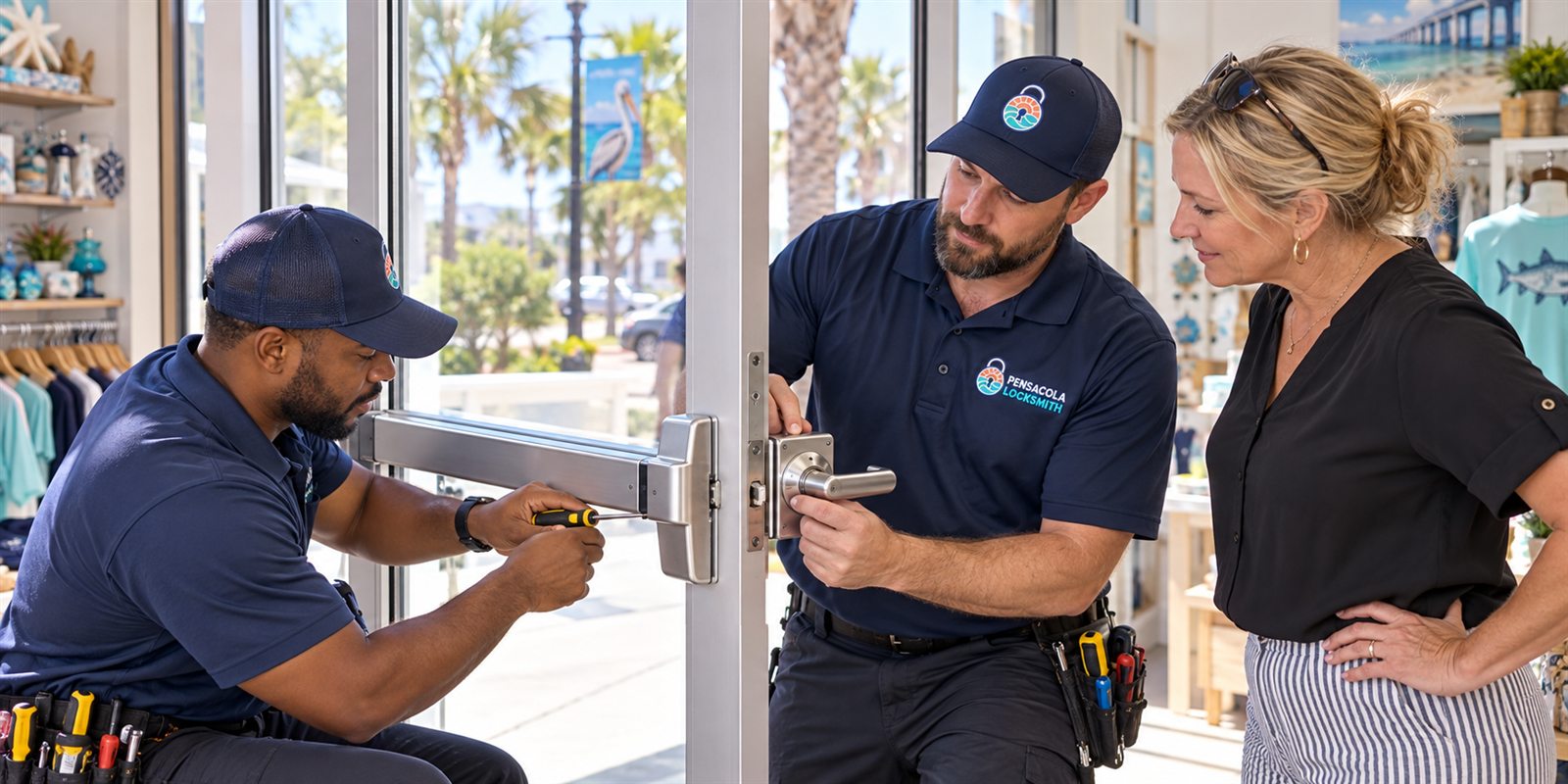
The technician starts by checking the existing hardware and measuring the door. In most cases, new cylinders fit into the existing lock bodies. Where the lock is old or worn, replacing the entire set is cleaner. The key bitting is chosen, the cylinders are pinned, and every key is tested in every lock.
Before the work begins, the locksmith confirms you own or are authorized to change the home's locks. Afterward, you decide how many keys to order and who holds the authorization. Many homeowners find that having a clear set of keys and a defined rule for copies gives a real sense of order, particularly after a move, a divorce or a long period of renters.
Setting up a system for a business
Businesses benefit from key control even more than homes because employee turnover is routine. A restricted system lets the owner decide who may receive keys and gives a basis for a written policy. Combined with a simple key log, it makes it clear who has access to which doors.
A more complete setup may use a hierarchy. A master key opens a set of doors, while individual keys open only their own. This is called a master key system, and it can be built on a restricted keyway for additional protection. Hierarchies take thought, because each additional level adds complexity, and a poorly planned system can create weak points.
The locksmith discusses your layout: front door, back door, storage, offices, equipment rooms, and who needs to reach each. Staff who need only one area get a limited key, while a manager gets broader access. When someone leaves, rekeying the affected cylinders is the clean way to remove their access without replacing everything.
Rental properties and property managers
Rental properties pose a particular challenge. Tenants come and go, and each departure leaves open the question of who still has a key. Rekeying between tenants is common practice for conscientious owners, and restricted systems add another layer by preventing the quick copying that frustrates it.
For vacation rentals along the Gulf Coast, where guests stay briefly and cleaners and managers rotate, tight key control is especially useful. Restricted keys make it harder for any one person to spread copies. Owners can combine them with lockboxes or keypads for guest access, keeping the main keyed cylinder for staff and the owner.
Property managers handling many units often use a single keyed-alike system for common areas and a restricted keyway for each unit. A clear record of which keys exist and where they are is the heart of the system. We confirm authority over each property before any work, so managers should have written authorization ready.

What changes in daily life
The main change is that spare keys take more deliberate effort. You can no longer pop into a store and have one cut in a minute. Instead, you plan ahead: order enough spares when the system is installed, keep one in a safe place, and think about who needs access before an urgent need arises.
This discipline has a quiet benefit. People start to treat keys as something that matters, not something to scatter. A key left with a neighbor is a decision, not a habit. A key given to a contractor is recorded and retrieved. Over time, the household or business ends up with fewer stray copies and a much clearer picture of access.
There is also a mild inconvenience when something goes wrong. If a key is lost on a trip, getting a replacement requires going through the proper process. That is the price of control. For many people it is a fair trade, and for others the effort feels unnecessary. We will describe it honestly so you can choose with eyes open.
Limits, honest tradeoffs and what it does not do
A restricted key system controls copying. It does not make a door stronger. If the frame is weak or the strike is short, forced entry remains possible. It also does not remove the possibility of lock picking or bumping unless the cylinder itself is built to resist them, which many restricted cylinders are, but you should confirm.
It can also add cost and time. Cylinders and keys are priced differently from ordinary hardware, and duplicates take longer to obtain. If you do not have a real key-sprawl problem, a good standard lock with sensible habits may serve you perfectly well. We would rather tell you that than sell something you will not benefit from.
Finally, any system depends on people. A restricted key in a drawer that nobody remembers, or an authorization card left in a car, loses much of its value. Pair the hardware with simple habits: a written list of keyholders, a secure place for spares, and a plan for rekeying when circumstances change.
How the process works when you call
Call us and describe the property, the number of doors, and what prompted your interest. We will talk through whether a restricted system is a good fit, and what the setup involves. Quotes are given by phone for straightforward jobs. For more complicated layouts, a technician visits and the service call charge is explained before dispatch.
On the day, the technician confirms ownership or authority, inspects each door, installs or rekeys the cylinders and tests every key. You are walked through the authorization record and shown how to order additional keys. Questions about future changes, such as adding an employee or replacing a lost key, are answered before the technician leaves.
Please call to confirm availability. If you are weighing options, we are glad to explain the difference between a restricted keyway and a standard rekey, and to help you choose what fits your situation, your doors and your habits, without pressure and without pushing features you do not need.
Key control habits that make the hardware worth it
Hardware sets the stage, but habits decide whether key control really works. Start with a simple written list: every key, who holds it, the date it was issued and the date it came back. A single page in a drawer is enough for a household, and a small spreadsheet works for a business. The act of writing it down is what changes behavior.
Next, decide where spares live. One spare in a secure place at home, one with a trusted person, and none under a flowerpot or hidden in the obvious places. For a business, keep spare and master keys in a locked box, and limit who can open it. A system with ten unaccounted keys is no better than an ordinary one.
Finally, plan for change. When an employee leaves, a tenant moves out or a relationship ends, treat it as a trigger to review. Rekeying the affected cylinders is usually the cleanest response, and a restricted system makes sure that the old key cannot simply be recopied. Making this routine removes awkward decisions and keeps the system honest.
Comparing restricted keys with rekeying, master keys and smart locks
Rekeying changes the internal pins of a cylinder so old keys stop working and new keys take over. It is a good first step for any property after a change of occupants, and it is often quicker and less costly than replacing hardware. A restricted system adds control over how new keys are copied, which rekeying alone does not.
A master key system lets one key open many locks while individual keys open only their own. It is excellent for organization and management, though each added level introduces some risk, since extra key combinations can make a lock slightly easier to compromise. Combining master keying with a restricted keyway helps keep the broader system under control.
Smart locks and keypads remove the physical key from the daily routine and let owners issue and cancel codes. They have their own concerns, such as batteries, software and weather. Many properties use a hybrid: a keypad for daily use and a restricted keyed cylinder as a backup. The right mix depends on how people actually use the doors, and we can talk it through.
Local situations where key control comes up often
Pensacola has a lot of properties where the key question is real. Vacation rentals near the beaches see guests, cleaners and managers rotate through, and a single missing key can affect many stays. Owners often want a system that makes sure that keys are not copied casually and that any change in management is easy to handle.
The area also has a large student and military population with frequent moves. Landlords with units near the university, the college or the naval air station face regular tenant changes and need a repeatable process for rekeying and key issue. A restricted keyway makes the process more predictable, because copies must come through a known channel.
Small businesses, from offices to shops and workshops, face seasonal staff and part-time workers. A restricted system gives owners confidence that a key given to a seasonal employee will not turn into several copies. Whatever the setting, we ask about the property, confirm authority to change locks and shape the system around how you really operate.
Planning the number of keys and the order of the work
Before the installation, sit down and count. How many people live or work in the property, how many doors, and which doors need to share a key? Underestimating is the usual error, because spares become slower to obtain once the system is in place. A small buffer of extra keys, kept securely, is far easier to manage than a rushed reorder.
The order of work matters too. The technician typically starts with the most important doors, tests the keys, and then moves on to the rest. For a business, it is wise to schedule the work at a quiet time so staff are not locked out partway through. For a home, make sure someone is present who can confirm authority and receive the keys.
Afterward, collect the old keys where possible and keep them separate in case a door was missed. Test every door yourself, including the ones used rarely, such as a side gate, a shed or a storage room. Reporting any stiffness right away allows an adjustment while the installation is still fresh and the details are easy to trace.
Common questions
Can any locksmith copy a restricted key?
Generally no. The blanks and the key records are controlled, so a copy requires the authorization the system calls for, such as a card or registered account. That is the purpose of the system. Ordering spares at setup is the easiest way to avoid delays later.
What if I lose my authorization card?
Contact us as soon as you notice. Replacing the record usually requires proof of identity or ownership, and it may take longer than an ordinary key copy. Keep the card in a safe place separate from your keys so a single loss does not leave you without either.
Is a restricted keyway pick resistant too?
Often, but not automatically. Many restricted cylinders include security pins or sidebars that resist picking and bumping, while others focus mainly on copy control. When choosing a system, ask what the specific cylinder resists so you know exactly what you are getting.
Can existing locks be converted to a restricted system?
In many cases the cylinders can be replaced while keeping the existing lock bodies. Older or worn hardware may need full replacement. A technician inspects the doors, confirms your authority over the property and explains which approach fits before starting work.
How do I get a quote?
Call us with the number of doors, the type of property and what you want to control. Quotes are given by phone for simple jobs. If the layout is complex, a technician visits and the service call charge is explained before dispatch. Please call to confirm availability.