
Content note: this page was written by Claude (AI) for Pensacola Locksmith.
Scandinavian restraint, applied to keys
Many owners describe their vehicle as understated, and the keys follow suit. Compared with the bulky multi button fobs of some brands, a typical Volvo fob is slim, with only a few controls. Behind that simple look sits a system just as serious as anywhere else, with coded chips, encrypted radio messages and an immobilizer that keeps the engine quiet unless it hears the right answer.
The slimness has practical consequences. A thin fob has less room for a large battery and less room for protective padding, so it is a little more vulnerable to bending and to water. Many owners keep it in a pocket with coins or other keys, which scratches it and strains the case. A soft pouch or a separate pocket helps.
If you are unsure what you have, look at the fob and think about how you use it. Does it fit into a slot in the dashboard, or do you simply press a start button with the fob somewhere in the cabin? Does it have a visible blade, or does the blade fold or slide out from a release? Describe those features by phone and the technician can start planning before arriving.
The key types you are likely to meet
Broadly, three types appear. The first is a traditional blade key with a chip in the head, used on older vehicles. You insert it into the ignition and turn. The second is a remote key where the blade and remote are combined in a single unit. The third is a proximity fob that needs no insertion and relies on the vehicle sensing it when you approach or sit inside.
Each type calls for a different set of tools. A blade key needs an accurate cut and chip programming. A remote key adds the radio part, which must match the vehicle's frequency. A proximity fob requires enrollment of a coded transmitter, and often a cut emergency blade for use in the door lock if the fob battery is weak.
The exact family within each type varies, and it is the vehicle identification number that settles it. A technician reads the number and checks what the vehicle was built with. Guessing from appearance alone is risky, since similar looking fobs can contain different electronics. If you can photograph both sides of your key and the dashboard area, it helps the planning.
- Blade key with a chip in the head
- Remote key with an integrated blade
- Proximity fob with push button start
- Slim fob with a hidden emergency blade
Why we ask who you are before we start
A vehicle built around safety deserves a careful approach to access. Before opening a Volvo, cutting a key or programming one, a technician confirms that you own the vehicle or are authorized by the owner. This is not a formality. Keys are the gate to a vehicle worth a lot, and the check keeps that gate from being opened by someone who should not have it.
In practice, this means showing identification and something that ties you to the vehicle, typically the registration or title. If your name does not appear, perhaps because the vehicle belongs to a spouse, a parent or a company, say so when you call. We will explain what documentation suits the situation, so you do not waste time at the vehicle.
The same check applies even if you are standing next to your own vehicle with your own keys in hand but the keys do not work. A technician cannot tell by looking that the vehicle is yours. The consistent process protects everyone, including you in a future moment when someone else tries to claim your vehicle. We think that is a fair trade for a few minutes of paperwork.
How a technician works through a Volvo key job
At the vehicle, the technician reads the identification number, matches it to the key family and prepares the right parts. If a blade is needed, it is cut on a portable machine and tested in the door. A blade that is slightly off might still turn once but catch later, so the test includes inserting and removing it several times to confirm smooth action.
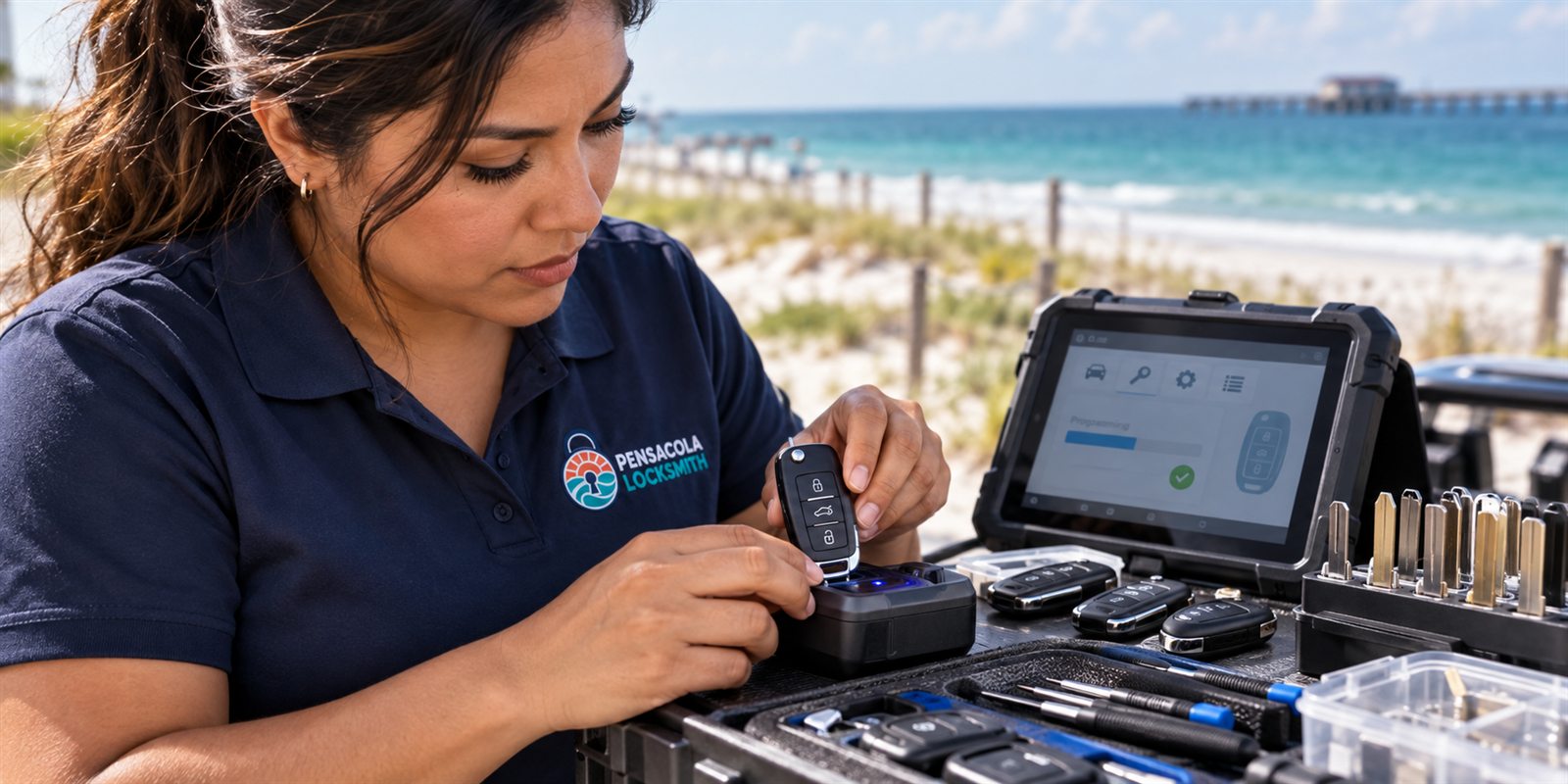
The diagnostic connection comes next. The technician plugs a tool into the service port, typically under the dashboard on the driver side, and the tool starts a conversation with the vehicle's modules. The vehicle may request a security handshake before it will accept a new key. The technician follows the sequence, introducing the new key and confirming that it is stored.
Finally, every function is tested. The engine starts and runs smoothly. The remote buttons work. The proximity detection finds the fob at each door and inside the cabin. If you have multiple fobs, each is tested individually. At the end, you are told how many fobs the vehicle recognizes, so there is no mystery later about the number in circulation.
When the only key is gone
Losing the only key is more involved than copying one you hold. The vehicle needs a first key introduced without a working one to guide it, which means the technician interacts more deeply with the immobilizer. On some Volvo systems this is routine. On others it requires extra steps or specific data. The technician will tell you plainly which case applies to your vehicle.
If your vehicle is locked, the first task is gaining entry without damage. Door seals and trim on these vehicles are precise, and careless tools can leave marks. A technician uses entry methods designed to avoid scratches and to avoid triggering airbag or door sensor faults. If an alarm sounds, it generally stops once a valid key is introduced or the door is opened from inside.
If there is any chance the missing key is in the wrong hands, have it removed from the vehicle's memory during the same visit. Only the keys you present afterward will start the engine. If a complicated situation arises, such as an unusual system or a prior failed attempt, a technician visits first and the service call charge is explained before dispatch. Call us to discuss and confirm availability.
Battery symptoms and the emergency routines
A fading fob battery announces itself in a few ways. The dashboard may display a message about the key. The unlocking range shrinks. You might need to hold the fob close to the door handle. Replace the battery at the first sign. A fresh cell is far cheaper in effort than a stranded morning, and it is a task many owners can do themselves with care.
If the fob goes completely dead, most vehicles have a fallback. You may be able to open the door with the hidden blade, and start the engine by placing the fob in a particular spot, such as a pocket in the console or against the start button. The owner's manual explains where. Practice this once while you are calm, not for the first time in a rainy parking lot.
When opening the fob to change a battery, be gentle. Slim cases are often held by small clips and a screwdriver used roughly will crack them. Note the orientation of the cell, and avoid touching the contacts with your fingers. If you would rather not risk it, a technician can change the battery and test the fob for you in a minute or two while at your vehicle.

Coastal living and the slim fob
Spending time near the Gulf means exposing your fob to humidity, sand and salt. A slim fob has fewer seals than a bulky one, and moisture can reach the board. After a beach day, dry the fob thoroughly. If it has been submerged, remove the battery right away and let it air out. Do not turn it on to test it before it dries, since power on wet circuits invites corrosion.
Heat also takes its toll. A fob left in a parked vehicle on a summer afternoon can reach high temperatures, and the glue holding the case together may soften. The battery may swell slightly. Take the fob with you rather than leaving it in a cup holder or on the dash. A small habit with a large payoff.
During hurricane season, check your keys as part of your preparations. Replace weak batteries, make sure a spare is stored in a dry, safe place and consider carrying your registration and a photo of the vehicle identification number with you if you evacuate. If you end up in another town needing help with a key, those items make the process much smoother.
Spares, and how many the vehicle can remember
A spare is most useful when it is made before it is needed. With a working key present, the technician can usually add another without erasing anything, and the vehicle remains calm throughout. Waiting until the last key is lost turns a short job into a longer one. If you hold only one key today, that is your cue to act.
Vehicles have a limit on how many keys they can store. Often it is a generous number, but used vehicles may already have several entries from previous owners. A technician can check what the vehicle currently remembers and recommend clearing entries you do not recognize. That is especially wise when you have bought the vehicle used and the history is unclear.
Choose your spare type thoughtfully. A full proximity fob offers convenience, while a simpler key may be more rugged. Some households keep one of each. Decide where the spare will live, and tell someone. Test it every few months. A spare that sits in a drawer for years with a dead battery is a surprise waiting to happen.
Honest limits for European vehicles
We want to be straightforward about a point that applies to many European vehicles: some key systems are more tightly controlled than others. Certain model families need security data or procedures that are not available to every locksmith. In those cases, a mobile technician may not be able to complete the job, and it would be wrong to pretend otherwise.
When that happens, you will hear about it early, ideally during the phone call or at the start of the visit. We explain what is needed, what alternatives exist and whether it makes sense for a technician to come out. If a visit is needed to assess, the service call charge is explained before dispatch, so you are not surprised.
There are also cases where the key is not the issue. A weak vehicle battery, a failed starter relay or a faulty security module can mimic a key problem. A technician will check the basics before suggesting a new key. If the fault lies elsewhere, you will be told, and you can seek the right repair. Honest diagnosis serves you better than an unnecessary replacement.
A short checklist before you call
Have these ready: the vehicle identification number, your identification, the registration or title, and any keys you still own, even damaged ones. Note how the vehicle starts and what the dashboard displays when you try. Describe where the vehicle is and whether it can be moved. These details let a technician plan the right parts and tools.
Think about what you want from the visit. Do you need just one key, or two? Do you want old keys removed from the memory? Do you want a spare blade as well? Saying so up front lets the technician prepare and often saves a second trip. If you are unsure, ask for advice. A good technician will not push more than you need.
Finally, relax. Key work is routine, and most vehicles can be handled on site. Even a lost key situation is a solvable problem. Call us, describe what has happened, and we will explain the process, confirm availability and give you a quote by phone. If it turns out to be more complex, we will say so and explain the charge before sending anyone.
Family safety features and what a key does not touch
Owners often ask whether replacing a key will disturb the safety systems the brand is known for. In general, it will not. Airbags, collision warning and stability control are separate systems, and a key job only deals with the immobilizer, the remote and the proximity link. A technician connects to the vehicle in a limited way and does not change those settings.
There is one point to watch, which is the vehicle's battery. Programming sessions can draw on the vehicle's power, and a weak battery may cause the process to fail or leave modules in an odd state. A technician may connect a power supply to keep voltage steady, and may suggest a battery check if the vehicle has been sitting for a long time.
If anything unusual appears on the dashboard after the work, such as a warning that was not there before, tell the technician immediately so it can be checked at the vehicle. Most such messages clear after a short drive or a restart, but it is better to confirm than to guess. We would rather you leave with a calm, normal dashboard.
Common questions
Can a Volvo fob be programmed at my home?
In many cases, yes. The technician comes to the vehicle in Pensacola or the surrounding area, confirms ownership, identifies the key family and programs the fob with diagnostic equipment. Some systems need extra data or procedures. Call us with your vehicle details and we will tell you honestly what applies.
What if I only have one key and it is failing?
That is the best time to act. With a working key present, adding a spare is usually simpler than starting from nothing. Describe the symptoms to us, such as worn buttons or a fading range, and we can discuss whether to make a spare, replace the battery or both.
Will removing old keys affect my current one?
It can, so every key you want to keep should be present during programming. Many systems rebuild the key list in one session, and keys not re-enrolled stop working. This is a good security step after a lost key. Tell us what you want when you call and the technician will plan it.
Do you ask for documents even if I am at my own vehicle?
Yes. We check ownership or authority before opening, cutting or programming, because the technician cannot tell ownership just by looking. Identification plus a registration or title is usual. If the vehicle belongs to someone else or to a company, tell us on the phone and we will explain what is acceptable.
What if my vehicle needs data you cannot reach?
We will tell you early. Some European key systems depend on information or procedures that are not available to every locksmith. In that case you will hear the options plainly. If a visit is needed to assess the situation, the service call charge is explained before dispatch.