
Content note: this page was written by Claude (AI) for Pensacola Locksmith.
Stop and search before you do anything else
Before you call anyone, take ten calm minutes to search properly. Most keys declared lost are found within a short distance of where they were last used. Retrace your steps in order, starting from the last time you remember using the key. Check the pockets of the clothes you wore, bags, the car seats if you can see in, the ground near the car, and anywhere you set things down.
Check places that are easy to overlook. Look in the washing machine and dryer if you did laundry, in the trash if you cleared out your car or bag, in grocery bags, and in a coat you wore the day before. Ask the people you were with. Contact any place you visited, such as a store or restaurant, since keys are often handed in at a front desk.
Search before ordering a replacement because a key found afterward is a wasted job. At the same time, do not search forever. If you cannot find it after a reasonable look and you need the car, moving on to the next steps is sensible. If you think the key may have been stolen rather than lost, treat the situation more seriously, as described below.
Decide whether it is lost or stolen
The difference matters. If your key vanished along with a wallet, bag or phone that holds your address or registration, someone may know where your car is and have the means to open it. In that case, you should not simply replace the key and carry on. You should consider that the old key is a security risk until the car's system no longer accepts it.
If the key may be in the hands of someone else, contact the police and report the theft. For the car itself, think about where it is parked and whether it is safe. If possible, move it or make sure it is in a well-lit, visible spot. When a replacement key is made, ask that the lost key be removed from the car's memory so that it can no longer start the vehicle.
On many modern cars, a locksmith with the right equipment can delete the old key from the car's records. For older vehicles with purely mechanical locks, rekeying the ignition and doors changes which key works. Mention your concern when you call, so the technician can plan accordingly. It is a sensible precaution whenever there is any doubt about where the key went.
Check for a spare, and think about who might have one
Many people forget that they have a spare. Think through the possibilities. Is there a second key in a drawer at home, with a family member, with a spouse or roommate, or in a lockbox? Did the dealer or previous owner give you two keys at purchase? Some owners keep a spare at work, in a safe, or with a trusted friend.
If a spare exists, the problem becomes much simpler. Retrieve it, and then have a new spare made while you have a working key, so that you are never down to one again. A new key can be copied from an existing key more easily than created from nothing, and it generally takes less time and effort.
If the spare is far away, consider whether someone can bring it to you. A relative across town with a spare key can often solve the problem faster than any other route. Just be careful about sending keys through the mail or with strangers. Hand it over directly if you can, and keep it with you rather than leaving it in a hidden spot.
Gather what a locksmith will need
A replacement key cannot be made for just anyone. Whoever makes it must be sure you have the right to have it. That means proof of ownership. The usual set is a registration or title for the vehicle and a photo ID that matches the name on the document. If the car is leased or financed, the registration still usually shows your name, but ask if the lessor has special rules.
Gather the vehicle information too: make, model, general year, and the vehicle identification number, which is on the dashboard near the windshield, on the driver door jamb and on your registration. The number lets a technician look up the key code or the right key blank. Take a photo of it if you can, so you can read it out over the phone.
Also note what kind of key you had: a plain metal key, a key with a plastic head, a flip key, or a smart fob with a start button. This tells the technician whether programming will be needed. Having this ready makes the phone call short and productive, and helps you get an honest answer about what can be done at your location.
- Registration or title and a matching photo ID
- Make, model and general year of the vehicle
- Vehicle identification number if you can read it
- The type of key you had: metal, chip, flip or smart
How a replacement key is made
For older cars with a plain metal key, the process is mostly cutting. A locksmith can find the key code from the vehicle's identification number or read the lock itself, then cut a new key to match. If the car has no code available, the technician may decode the lock or, in some cases, take the lock apart to read the pins. These methods work on site for many vehicles.
For cars with a transponder chip, there is an extra step. The new key has to be cut and then programmed to the car so that the engine will start. Programming requires connecting a tool to the car, which reads and writes the key information. For many vehicles, this can be done at your location. Some cars need extra security steps, such as waiting for a timed process or obtaining a code.
Smart keys with push-button start are the most involved. They contain a chip and an antenna, and their programming can be more restricted. Some are doable on site, while others require specialized equipment or a dealer procedure. A technician will tell you honestly which situation applies. Being clear about the limits of a roadside job is better than leaving you waiting on something that cannot be done there.
Getting into the car if the key is lost
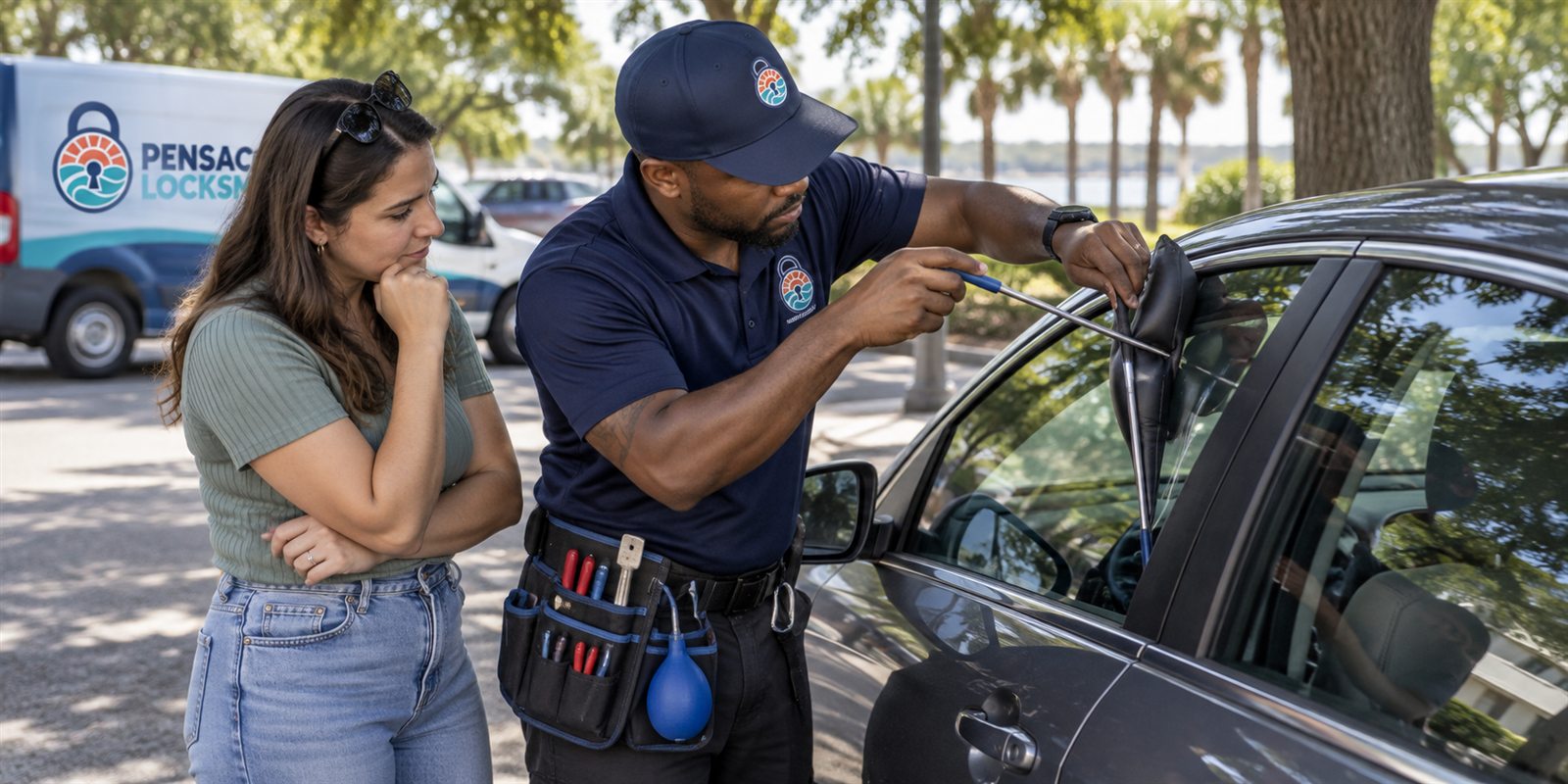
If your key is lost and the car is locked, you may need access before anything else. A locksmith can usually open the vehicle without damage, after confirming you own it. This is different from making a key, and can be done first so that you can retrieve your belongings, check for the key inside, and prepare for the next steps.
Sometimes the lost key is in the car. Once the doors are open, you may discover it under a seat, in a cup holder or in a bag. This is a common outcome, and it is another reason to search carefully before ordering a replacement. If the key is locked inside, an unlock may be all you need.
Never try to break a window or force the door yourself. A broken window is expensive and leaves the car open to weather and theft. A gentle professional entry usually costs less in the end. If a child or animal is trapped inside, call emergency services immediately rather than waiting for a locksmith, especially in the heat of a Gulf Coast day.
Dealer or locksmith: how to choose
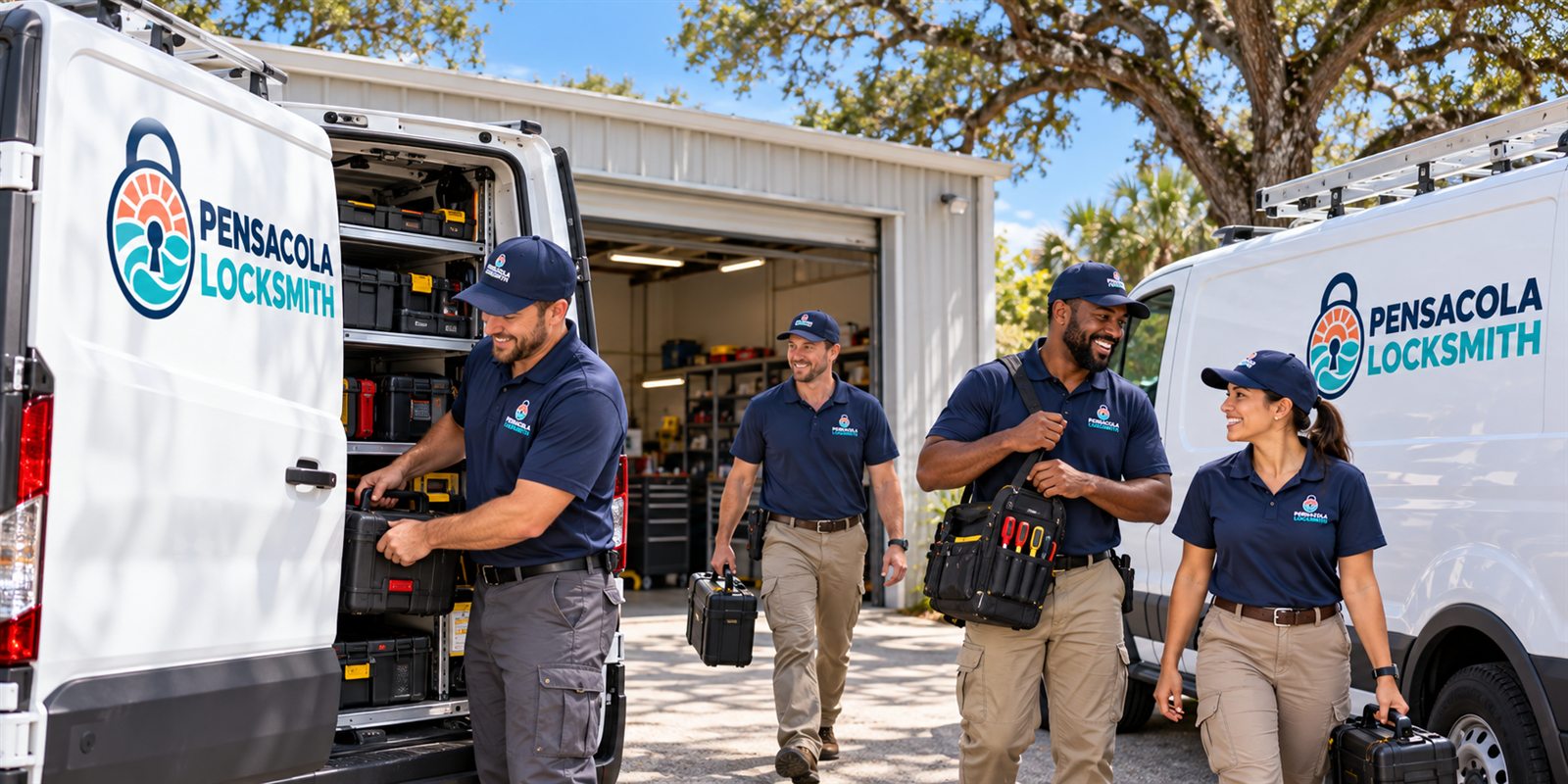
There are generally two routes to a new key: the vehicle's dealer, and an independent locksmith. A dealer can order keys for almost any vehicle they sell, but the process often requires the car to be brought to them, which may mean towing. Ordering parts can take time. A mobile locksmith comes to the car, which avoids the tow and often finishes the work in one visit.
A locksmith may not be able to handle every vehicle, especially some newer or more restricted models. In those cases the dealer is the right place. A good locksmith will tell you at the beginning if your car falls into that group. It is worth a phone call to find out, since the answer shapes your whole plan and may save a tow.
Whichever route you choose, ask what is involved, what documents are needed, and whether the old key will be removed from the car. Ask for a quote before work begins. Quotes for straightforward jobs are given by phone, and for complicated ones a technician visits and the service call charge is explained before dispatch. Call us to confirm availability.
What not to do
Do not leave the car unlocked and hope for the best. If the car is in a public place, a lost key and an open door is a poor combination. Do not hide a note or a spare in an obvious place such as a wheel well, bumper or under the mat. Thieves know every one of those places.
Do not buy a random key online and hope it will work. Blank keys and fobs sold online are often the wrong type, locked to another car, or poorly made. A key that is cut but not programmed will turn in the door but will not start a car with an immobilizer. Money spent on the wrong part is wasted, and the programming may still be needed.
Do not pass your registration, ID or vehicle number to anyone who contacted you without being asked. Scams exist, and you should only share details with a service you chose to call. Likewise, never hand over your car to someone who cannot explain what they will do. A trustworthy locksmith asks for proof of ownership because it protects you.
Protecting the car in the meantime
Until a new key is made, think about the car's safety. If it is at home in a garage or driveway, it is probably fine for a day or two. If it is on a street, in a lot or at a workplace, consider whether it is likely to be targeted and whether it can stay there. Check with the lot owner about time limits, because some places tow vehicles that stay too long.
If you suspect the key was taken, consider that the car could be driven away. Report it, and ask the technician to disable the old key when making the new one. If the car has a tracking feature through its manufacturer or a phone app, check that it is working. Keep your registration and personal documents out of the car, since a thief with a key and your address has more than he needs.
Take a moment to also think about other keys on the ring. If your house key, garage key or office key was on the same ring as the lost car key, those locks may now be at risk. Depending on how and where it was lost, rekeying them might be worth considering. A locksmith can discuss the options for your home as well as the car.
Making sure it does not happen again
Once the immediate problem is solved, take steps so that you are not here again. Have at least two keys for the car and keep them in different places. Give one to a trusted person or store it securely at home. Test each key periodically to make sure it still works and has a fresh battery if it is a fob.
Consider a tracker for your keys. Small devices that attach to a key ring can help you find it with a phone. They are not perfect, and they should not carry your address or any identifying information, but they can turn a lost key into a short search. Whatever you choose, do not attach your name and address to the ring.
Finally, build a small habit: a dedicated place for the key every time you come home, and a check before you leave anywhere. Most key losses happen when routines are disrupted. A simple routine protects against a stressful day. If you need help with a lost key or a spare, call us, describe the vehicle and the situation, and we will explain the next step.
What to expect on the day of the visit
When the technician arrives, expect questions before any tools come out. They will confirm who you are, look at your documents, and check that the vehicle matches the paperwork. Then they will look at the locks and ignition to decide the method. If anything is unclear, they will explain the options, including the limits of what can be done at the roadside.
The work itself varies. For a mechanical key, cutting may take a short while once the code is known. For a chip key, cutting is followed by programming, during which the technician connects equipment to the car and registers the new key. Keep your phone and other electronics away from the car during programming if asked, since interference can interrupt it.
At the end, test everything. Open and lock each door with the new key. Start the car several times. Try the trunk and glove box if they use the same key. Ask about spare keys and the cost of adding one while the technician is there, since a second key is easiest to make in the same visit. Keep the receipt and note which key was added to the car.
Common questions
Can a locksmith make a car key if I have no key at all?
In many cases yes. A technician can cut a key from the vehicle's code and program it if needed, after confirming ownership. Some newer or restricted vehicles may need a dealer procedure. Describe the car and the key type on the phone and we will explain what is possible.
What proof will I need?
Usually the registration or title and a photo ID that matches. If the car is leased or owned by a company, authorization from the owner may be needed. We check ownership before making or programming any key, which protects you and your vehicle.
Should I worry that someone else has my lost key?
If the key may have been stolen, or was lost with documents showing your address, yes. Report it and ask that the old key be removed from the car's memory when the new one is made. For older cars, rekeying the lock stops the old key from working.
Can I order a key online instead?
It is risky. Online keys are often the wrong type or locked to another vehicle, and a key with a chip must be programmed to your car before it will start the engine. Programming still requires proper equipment and proof of ownership.
Will you come to my car?
We are a mobile service, so we can usually come to the vehicle. Please call us to confirm availability for your location, because we cannot promise an arrival time. Quotes for simple jobs are given by phone, and complicated jobs begin with a visit and a service call charge explained before dispatch.