
Content note: this page was written by Claude (AI) for Pensacola Locksmith.
What the term really means
There is no single legal definition of a high-security lock, which is why the phrase gets used loosely. In practice, it describes a cylinder and key combination that has been designed to withstand common attack methods for longer than an ordinary builder-grade lock. The design work shows up in the pins, the keyway shape, the hardened inserts inside the cylinder and the way the key itself is cut.
A standard pin tumbler lock, the kind found on most homes, relies on five or six spring-loaded pin stacks. Those stacks are forgiving. Loose tolerances and simple keyways make them easy to manufacture and easy to pick with patience. A high-security version tightens the tolerances and adds extra elements that confuse a pick or a bump key.
The result is a lock that costs more in materials and takes more care to install, which is fair to say plainly. Whether that tradeoff is worth it depends on what the lock is protecting and who might want to get past it. We will talk that through by phone before anything is scheduled, so you are not guessing.
How pick resistance is built into a cylinder
Pick resistance usually comes from security pins. Instead of a plain flat-sided driver pin, the cylinder uses spool, serrated or mushroom-shaped pins. When someone applies light tension and lifts the pins one at a time, these shapes catch and give false feedback, so the pick feels like it has set a pin when it has not. It takes real skill and time to work through them.
Better designs go further with a second locking element. Some cylinders add a sidebar that must also be aligned by grooves milled into the side of the key. Others use a secondary row of sliders or rotating discs. The pick has to defeat both mechanisms at once, which multiplies the difficulty far beyond adding another plain pin.
None of this makes a lock unpickable, and an honest technician will not say it does. What it does is raise the skill, tools and time required, and it removes the quick, casual attacks that work on cheap hardware. A lock that takes a long time to defeat is a lock that most opportunists will walk away from.
Bump keys, drilling and the other common attacks
Picking is not the only way past a lock. Bumping uses a specially cut key and a sharp tap to jump the pins momentarily, and it works against many ordinary cylinders in seconds. Drilling attacks the shear line directly. Snapping targets the weak point of some euro-style cylinders. Forced entry through the strike or door frame skips the lock altogether.
High-security cylinders answer these in different ways. Bump resistance often comes from the same security pins and from sidebar or rotating elements that do not respond to a simple tap. Drill resistance comes from hardened steel pins and plates set where a bit would be aimed. Anti-snap features are built into the cylinder body to break cleanly in a safe place.
The honest caveat is that a cylinder is only one part of a door. If the strike plate is held by short screws into soft trim, or the frame is cracked, the best cylinder in the world will not matter. A technician looking at a security upgrade should always look at the whole opening, not just the part that holds the key.
Restricted keyways and key control
The second half of high security is key control. A restricted keyway is a profile that is not sold openly. Blank keys for it are held under controlled distribution, so a copy requires proof that you are authorized to make one. That is very different from an ordinary key, which can be duplicated at almost any hardware counter without a question asked.
Control matters because the strongest lock in the world is useless if a former tenant, contractor or employee still has a working copy. With a restricted system, the authorization record, often tied to a card or a registered account, is what stands between a key and a stranger. The physical key may even carry a warning stamped on it.
There are tradeoffs. Duplicates are slower and more deliberate to obtain, which is exactly the point but can be inconvenient when you need a spare quickly. Ordering a good number of spares at setup time is wise. We cover the full key control picture on our restricted key systems page, and we will talk it through before you commit.
Who tends to benefit from high-security hardware
Not everyone needs this level of lock, and we are happy to say so. A standard, properly installed deadbolt with a solid strike on a sturdy frame handles most ordinary homes well. The upgrade starts to make sense where the consequences of a break-in are larger or where key sprawl is a real problem.
Common examples include rental properties with changing tenants, small businesses storing inventory or cash, offices holding client records, medical or professional suites, storage rooms for tools and equipment, and homes with valuables or a home office. Vacation rental owners near the beaches often want tight control over who holds keys across many guest turnovers.
It can also suit people who simply want a quieter mind. A resident who has had a key lost or a past break-in nearby might choose a better cylinder as a one-time improvement. We always describe what the upgrade protects against and what it does not, so the decision is yours and you are not being sold something you will not use.
What the installation process looks like
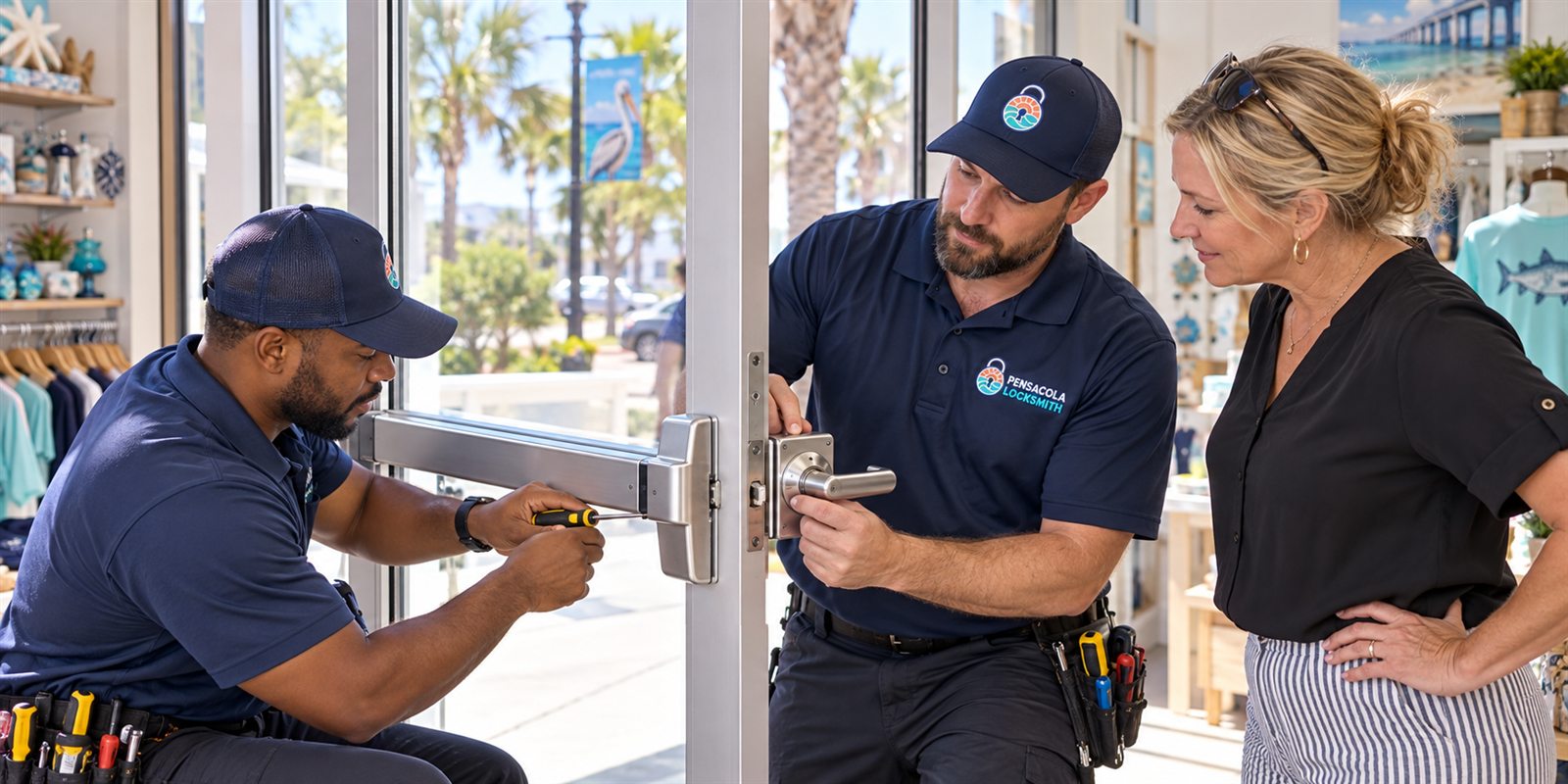
A good installation starts with checking what is already on the door. The technician measures the door thickness, the bore and backset, confirms the existing latch and deadbolt type, and looks at the condition of the strike and frame. High-security cylinders often come in standard formats that fit common hardware, so many jobs are a cylinder swap rather than a new door prep.
Where a full deadbolt replacement is needed, the technician installs a hardened bolt with a deeper throw, reinforces the strike with longer screws that reach the framing behind the trim, and checks alignment so the bolt extends smoothly. Misalignment is one of the most common reasons a good lock feels poor, and it is easy to correct during installation.
Before any work, the locksmith confirms you own the property or have authority to change its locks. Once installed, each key is tested several times, the spare count is agreed, and the technician explains how to request additional copies. If the job turns out to be more complex than the phone description suggested, a technician visits and the service call charge is explained before dispatch.
Living with your system: spares, records and tradeoffs
Once you have a restricted system, a few habits keep it working well. Keep any authorization card or registration information in a safe, separate place from the keys. If it is lost, getting copies can become difficult, and you may need to prove your identity again. Treat that card like a deed to your key system rather than a loose piece of paper.
Decide early how many keys you actually need and who should hold them. Write down who has what. If you run a rental or a business, a simple log of keys issued and returned is worth more than any hardware feature. When someone leaves, the cleanest answer is often to rekey the cylinder so the old key stops working.
The tradeoffs are real and worth naming. Keys cost more to copy, the process takes longer, and replacement cylinders may need to be ordered. In exchange, you gain a measurable increase in resistance and a record of who is allowed to duplicate. For many properties that exchange is a good one, and for others a simpler lock is perfectly appropriate.
Coastal conditions and long-term maintenance
Pensacola sits on the Gulf Coast, and salt air and humidity are hard on door hardware. Corrosion attacks springs, pins and the finish of exposed cylinders, especially on doors facing the water or on covered porches that still catch moisture. Quality cylinders hold up better, but nothing is immune, and a lock that sticks is a lock people start propping open.
Basic care helps. Use a dry graphite or a lubricant approved for locks rather than a heavy oil that attracts grime. Do not spray household oil into a cylinder. Wipe the keys occasionally, because worn or dirty keys wear the pins faster. If a key begins to feel gritty or requires jiggling, mention it early, since forcing a key can bend or break it inside the lock.
During hurricane season, doors and frames can shift slightly with humidity and settling after storms, which sometimes throws the strike out of line. If the bolt starts dragging, a quick adjustment is far better than letting it get worse. A technician can service the hardware in place and confirm the whole opening still operates the way it should.
How to decide and what to have ready when you call
Start by listing the doors that matter most. Front and rear entries, an office or storage room, a detached shop or a rental unit are the usual candidates. Note whether the doors are wood, steel, fiberglass or aluminum storefront, and whether the locks are keyed on one side or both. That description lets us tell you a lot over the phone.
Tell us what is bothering you. Is it lost keys, a past incident, a tenant change, or a general wish to tighten things up? The reason shapes the recommendation. Someone worried about copied keys needs a different answer from someone worried about forced entry, and often the best fix combines a better cylinder with a reinforced strike.
Have proof of ownership or authority handy, such as a lease, a utility bill or a management letter, because we confirm it before changing hardware. Quotes are given by phone. Please call us to talk it through and confirm availability. If your door needs a closer look, a technician will visit and explain the service call charge before dispatch.
Questions worth asking before you spend anything
Before agreeing to any security upgrade, ask what specific threat it addresses. If the answer is vague, the upgrade may be marketing rather than protection. A useful answer sounds like this: the cylinder resists bumping, the keyway is restricted so copies need authorization, and the strike now reaches the framing so a kick is less likely to split the trim. Specific answers let you judge value honestly.
Ask also how replacement keys and cylinders are obtained down the road. A system that depends on one supplier and a single card can become awkward if the card is lost or the property changes hands. Find out what proof is needed, how long a duplicate typically takes, and whether the cylinder can later be rekeyed to a new key pattern without replacing it entirely.
Finally, ask about fit with what you already own. Some high-security cylinders drop into standard hardware, while others require a matching deadbolt body or a particular mortise housing. Knowing this up front prevents surprises. A thoughtful technician will explain which parts of your existing hardware stay, which change and why, in words that make sense without trade jargon.
Common mistakes people make with security upgrades
The most frequent mistake is upgrading the cylinder and ignoring the door. A pick-resistant lock on a hollow, cracked or poorly hung door still lets a determined person through the weak point beside it. Reinforcement of the jamb, a proper strike with long screws and a door that sits square in its frame are part of any honest security plan.
Another mistake is buying many keys and then losing track of them. A restricted key system only works if you know who holds a copy. Handing spare keys to contractors, cleaners and guests without a record defeats the purpose. Even a basic written list of who has which key is an improvement over memory, and rekeying after a change is cheap insurance against surprises.
A third mistake is forcing or modifying a good lock. Hammering a stuck key, spraying thick oil into a precision cylinder or drilling out a lock to avoid a call often ruins an otherwise sound installation. If something feels wrong, stop early and call us. A small service visit now is nearly always cheaper in time and trouble than replacing damaged hardware later.
High-security locks for rentals and short-term stays
Pensacola has a large share of vacation rentals, student housing near the university and college, and homes rented to military families, so key turnover is a fact of local life. Every guest, tenant or cleaner who holds a copy is a potential gap. A restricted system narrows that gap because copies cannot simply be made at a convenient counter on a whim.
For rental owners, the practical approach is to pair a better cylinder with a clear key policy. Decide how many keys each unit needs, keep a master record of who holds them, and rekey between long-term tenants. Rekeying a quality cylinder is straightforward and usually quicker than replacing it, which keeps the cost of turnover manageable over time.
Some owners choose a keypad or smart lock alongside a keyed backup, so guest codes can be changed without touching the cylinder. That is a different tool from a high-security cylinder and has its own tradeoffs, which we cover on our access control page. Either way, we confirm authority over the property before any change is made.
Common questions
Is a high-security lock the same as a deadbolt?
No. A deadbolt is a type of bolt that extends into the frame. A high-security lock describes the cylinder and key design, with features that resist picking, bumping and drilling. You can have a high-security cylinder in a deadbolt, but a plain deadbolt with an ordinary cylinder is not high-security. The two work best together, along with a solid strike.
Can a high-security lock still be defeated?
Any lock can be defeated given enough time and the right tools, and an honest locksmith will tell you so. High-security cylinders raise the skill, time and noise required and stop quick, casual attacks. They are one layer of protection. A reinforced frame, good strike screws and sensible habits matter just as much as the cylinder itself.
Can I get extra keys made at a hardware store?
Usually not for a restricted system. The blanks are controlled and copying generally requires proof of authorization. That is the whole point, because it stops casual duplication. Plan to order spares from your locksmith when the system is set up, and keep any authorization card somewhere safe and separate from the keys.
Do I need to prove I own the property?
Yes. Before installing, rekeying or changing any lock, the locksmith checks that you own the property or have authority to make the change. A lease, a utility bill, a management letter or similar documentation usually works. It protects owners and tenants alike and is a normal part of responsible lock service.
How do I find out what it will take for my door?
Call us and describe the door, the current lock and what concerns you. Quotes are given by phone based on that description. If the job looks complicated, a technician visits to inspect the opening, and the service call charge is explained before dispatch. Please call to confirm availability for your location.