
Content note: this page was written by Claude (AI) for Pensacola Locksmith.
First, check that everyone is safe
Before you think about the car, think about people. Is anyone still inside, such as a child, an elderly passenger or a pet? If so, treat it as an emergency and call 911 right away instead of a locksmith. Emergency crews are equipped for that, and every minute counts in a closed vehicle, especially in warm weather. Only after everyone is accounted for should you work through the lockout itself.
Next, look at where the car is. A vehicle idling in a driveway is a different matter from one idling in a lane of traffic, on a boat ramp, beside a gas pump or in a crowded parking lot. If the car is blocking traffic, step to a safe place, turn on your phone's flashlight if it is dark, and call for help. Do not stand in a roadway to guard the car.
Finally, think about whether the car is in gear. If the engine is running and the transmission is in drive or reverse and the brake is the only thing holding it, it could creep. A locked car in park with the parking brake set is generally stable, but you should still keep your distance from the front and rear and tell the technician what you remember about the gear position.
Why a running engine changes the situation
A lockout with the engine off is only an inconvenience. A lockout with the engine running adds clock pressure. The engine uses fuel while it idles, the air conditioning or heater keeps running, and the exhaust continues to leave the tailpipe. In a closed garage, a running car is dangerous because carbon monoxide can build up. If the car is in a garage or carport attached to your home, open the garage door and keep people away from the area until the engine is off.
Modern engines idle efficiently, but they are not designed to run unattended for long periods. Extended idling in hot weather can raise engine temperatures, especially if the radiator fans or coolant are weak. In cooler weather, idling is less stressful, but the fuel gauge continues to fall. If you were already low on fuel before the lockout, the engine could stall before help arrives.
Some vehicles shut themselves off after a set time with the key fob absent, while others warn you, keep running or even lock out the start button once you stop the engine. If your car has push-button start, it may not restart unless the fob is inside the car, so a technician must handle the entry and the key situation together.
What to do right away
Take a calm inventory. Check every door, the trunk and the windows. Press the buttons on any spare fob, and try the key cylinder if the car has one. If you have a smartphone app that came with your car, try it, because many manufacturers provide an app that can unlock the doors remotely. You may need to sign in or confirm your identity, so only try this if you already set it up before the lockout.
Call someone who has a spare key. A family member, roommate or colleague may be able to bring it, and that is often the simplest answer. Think about whether a spare is hidden in a safe place at home, and whether the person fetching it can get there safely. Weigh that against the time and the fuel, and decide whether it makes more sense to call a technician.
If you decide to call a locksmith, gather information first. Know the exact location, the vehicle year, make and model, and whether the car has a key or a push-button start. Tell the technician the engine is running, because it affects how they plan to work. Call us to confirm availability and ask for a quote by phone. Quotes are given by phone, and complicated jobs are explained before dispatch.
Should you break a window
It can be tempting to smash a window and be done with it, but that usually costs more time and money than it saves. Side windows are made of tempered glass that shatters into small pieces, which scatter across the seats and door cavity, and the repair is a separate job that takes time to schedule. Replacement glass for many cars has to be ordered, and in the meantime the car is open to rain and humidity.
Glass breaking can also set off alarms, damage window regulators or wiring inside the door, and leave sharp fragments that get into the upholstery. If the engine is running and the car begins to move or the transmission shifts, an open window also means anyone could get in. For a simple lockout with no one inside, a skilled technician can usually open the door without damage.
There are rare exceptions. If a child or animal is trapped, or if the car is on fire or filling with smoke, call 911 and let the responders decide. For an ordinary lockout, the better choice is patience and a professional entry. Remember that the entry must be done by someone who can confirm you have the right to open the car.
How a mobile locksmith opens a locked running car
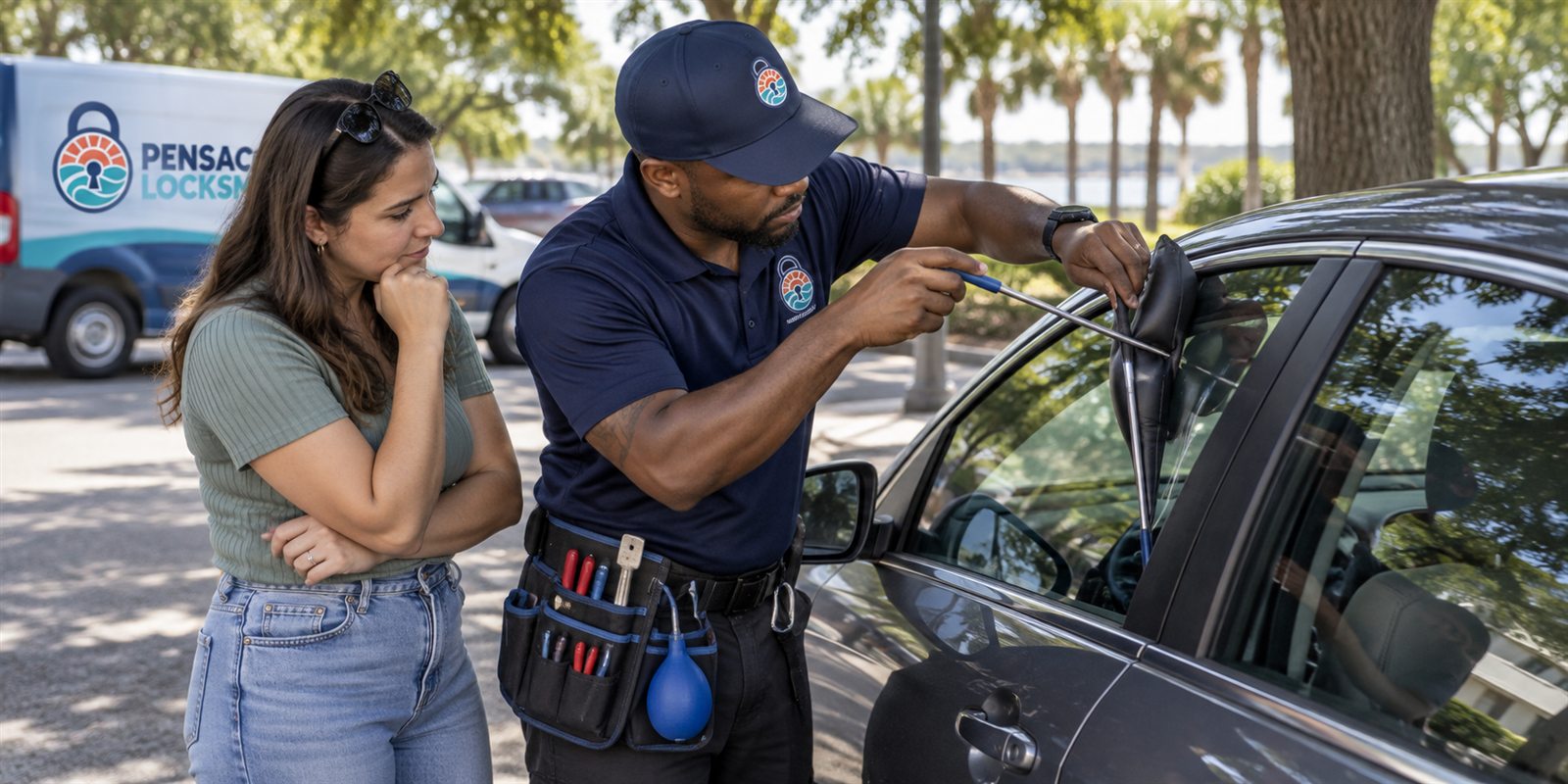
A trained technician has several ways to open a locked vehicle without damage. The most common is to slip a thin inflatable wedge between the door and the frame to create a small gap, then use a long-reach tool to press the unlock button or pull the interior handle. The wedge is soft and distributes pressure, which prevents bending of the door skin. The technician works carefully around weather stripping and sensors.
Other methods include using specialized picks and decoders on the door lock cylinder, if the car has one, or using electronic tools that communicate with the vehicle's systems where appropriate. The technician chooses the method that is least likely to scratch paint, bend metal or trigger the alarm. Some vehicles with side airbags and wiring in the door require particular care.
Because the engine is running, the technician will also pay attention to safe handling. They will avoid tools or methods that could trigger the car to shift or move, and they may ask you to stand clear of the vehicle's path. Once the door is open, they will help you get the key and shut the engine off. If the key is actually locked in the trunk, the technician can discuss options for entry.
Ownership checks and what to have ready
Before a locksmith opens any vehicle, the technician checks that you own it or have authority to open it. This is a routine step and a protection for you. Without it, anyone could claim to be the owner of any car. Expect to show a driver license and some proof connected to the car, such as the registration, the title, an insurance card, or a lease or rental agreement.
If you are driving a company vehicle, a car owned by a relative or a rental, explain this at the start of the call. The technician may need to verify authority with the owner or the rental company. Have the paperwork nearby, or know where to find it. For rentals, the rental company may also have its own roadside process, which you can ask about.
Tell the technician about anything unusual: an aftermarket alarm, a remote starter, a recently replaced battery in the fob or a recent repair to the doors. Mention if any passengers or items are inside. The more the technician knows, the better the plan will be. When a job is complicated, a technician visits and the service call charge is explained before dispatch.
Dealing with the fuel and the engine while you wait
While you wait, there is not much you can do to the engine from outside, but there are choices that reduce risk. If the car is idling in a safe spot, leave it that way rather than trying to open the hood or reach in through a gap. Do not attempt to shut off the engine with tools through a window crack or a door gap, because you could trigger the alarm or damage something.
If the weather is hot and the car's air conditioning is running, the cabin will stay cool, which is not a bad thing. In cold weather, the heater helps keep the interior from chilling. But a modern engine idling for a long time still consumes fuel and generates heat, so if the wait looks long, ask whether a technician can arrive soon and choose accordingly.
If you are low on fuel, tell the technician and be prepared for the possibility that the engine stops. Some cars can restart easily, while others with push-button start may need the fob to be inside before they will run again. This is another reason to share your car details when you call. Do not leave the car unattended for long if it is parked somewhere busy.
Keyless and push-button cars
Many newer vehicles use a proximity fob and a start button instead of a key. These systems let you drive away with the fob in your pocket, but they also allow some surprising lockouts. A fob can end up in a bag you set on the ground, in a pocket of a passenger who walked away or inside a car that locked itself because the fob went out of range. Some cars will not shut off or restart unless the fob is detected.
The good news is that these systems usually still have a mechanical backup. Most fobs hide a small metal key blade, and the car has a lock cylinder, often concealed behind a cap on the door handle. A technician who knows the vehicle can use this backup, but the exact approach depends on the manufacturer. If you do not know where the cylinder is, do not pry at the door handle.
If the fob itself is lost or damaged, the technician can often cut a new key blade and program a replacement fob after verifying ownership. That is a different job from a simple lockout, and it may require specialized equipment. Call us to describe your vehicle and your situation, and we can explain what is likely before anyone is sent.
Parking spots, bays and busy lots
Where the lockout happens affects how the work goes. In Pensacola, cars end up parked near the bay, the beaches, downtown streets, shopping centers, hospitals and base entrances. In a lot with heavy foot traffic, a technician needs a safe place to stand and open the door. Mention if the car is on a slope, in a loading zone, beside a boat ramp or in a space where the tide, rain or sand could matter.
During storm season, heavy rain and wind can make entry more difficult. Water inside a door can affect wiring, and a technician may need to protect the interior from the weather as the door opens. If you can move your car under cover before it is locked, do so, but if the lockout has already happened, leave it where it is and tell the technician what to expect.
If you are on or near a military installation, a university campus or a private property, the property manager or security staff may have rules about outside service providers. Ask in advance whether the technician needs to be cleared to enter. Call us to confirm availability and discuss anything about the location that might affect timing or access.
What to do after you are back in the car
Once the door is open, take a moment before you drive off. Check the gear position, set the parking brake if needed, and turn off the engine if you plan to stay. Find your keys, put them in a place you will not forget, and ask the technician to test the lock and handle to make sure nothing was disturbed. If an alarm sounded, make sure it is reset.
Think about why the lockout happened. Was it a fob that locked itself, a habit of leaving the engine running while you ran inside, or a spare you never made? Fixing the cause is better than just reacting. If you rely on a single key, consider having a duplicate cut and programmed, and keep it somewhere safe that is not in the car.
Finally, check the fuel and the engine temperature. If the engine ran for a long time, give it a moment to settle. If any warning lights came on, have the car looked at. Learn how your car locks, which door handle triggers locking, and what your fob does when it is out of range. A little knowledge prevents most repeat lockouts.
Simple habits that prevent a repeat
The best fix is a routine. Always take the key or fob with you when you leave the car, even for a moment. Develop a pocket or hook where it lives, and check it before you shut the door. For push-button cars, make it a habit to feel for the fob before you step out and to turn the car off before you leave it.
Keep a spare in a safe place. A duplicate key held by a trusted person is more secure than a magnetic box under the bumper, which thieves know about. Think about whether a spare would be useful at home, at work or with a family member. If you have a key blade hidden in your fob, know how to use it.
Check your car's settings, because some vehicles let you turn off automatic locking or change how the doors lock when you walk away. Review the owner manual for these options. If your key is worn, loose or sticky, replace it before it fails. When in doubt, call us to talk through what is possible for your vehicle.
Common questions
Is it safe to leave a locked car running while I wait for help?
Usually it is safe in an open, well-ventilated place if no one is inside and the car is parked securely. Never leave a running car in a closed garage, because exhaust can build up. Watch the fuel level and keep clear of the car's path in case it is in gear. If anyone is trapped inside, call 911.
Will a locksmith damage my car getting the door open?
A trained technician uses soft wedges and long-reach tools or picks the lock cylinder to avoid scratches or bent metal. The method depends on the vehicle. Tell the technician about the model and any aftermarket parts when you call so the right approach is planned before work starts.
What if my car has a push-button start and the fob is inside?
Most fobs hide a mechanical key blade and the car has a hidden door cylinder, which a technician can use. The car may not restart unless the fob is inside, so entry and key handling are planned together. Do not pry at the door handle. Call us and describe the model.
Do I need to prove the car belongs to me?
Yes. The locksmith checks ownership or authority before opening any vehicle. Keep your driver license and the registration, title, insurance card, or lease or rental paperwork ready. This step protects you and the true owner of the car, and it is a normal part of the process.
How do I get a quote for this kind of lockout?
Call us with your location, the vehicle year, make and model, and the fact that the engine is running. Quotes are given by phone. If the job is complicated, a technician visits and the service call charge is explained before dispatch. Call us to confirm availability before you make plans.