
Content note: this page was written by Claude (AI) for Pensacola Locksmith.
Why hospitality and retail run into key sprawl
In a restaurant or shop, many people need to open and close: managers, line cooks, servers, delivery receivers, cleaners, seasonal helpers and sometimes vendors. Each handoff creates another chance for a key to be copied, lent or forgotten in a pocket. High turnover means that the number of former employees who once held a key grows every month.
Coastal tourism makes this worse. Many local businesses hire seasonal workers, rely on short-term contractors and see a flood of new faces each summer. Keys issued in a hurry may not be recorded properly, and by autumn nobody remembers who had what. The result is a set of locks that effectively open to an unknown group of people.
None of this means your staff are untrustworthy. Most people are honest. But a business should not depend on goodwill alone to protect cash, stock and equipment. Rekeying is a straightforward way to reset the situation when the paper trail gets muddy, and it gives you a clean start without changing how the doors look or feel.
Staff turnover is the quiet driver of key problems, but not the only one. Landlords, property managers, alarm companies and contractors may all hold keys to your premises. Before rekeying, find out who has access and why. You may decide that some of these people still need a key, and that is fine, as long as you control who receives the new set.
Situations that call for rekeying
The most common trigger is a lost or unreturned key. If an employee leaves and cannot be sure where their key went, or a key was lost on a night out, rekeying the affected doors closes the gap. Another trigger is a termination that did not go smoothly, where an upset former employee might still hold access.
Buying or taking over a business is another strong reason. You do not know how many copies of the old keys exist, and previous owners, managers and landlords may each hold some. Rekeying on day one gives you control of every door. The same logic applies when you move into a new unit or lease a space previously used by someone else.
Break-ins and attempted break-ins are also reasons to review your locks. Even if nothing was taken, you may want to check hardware and rekey as part of the repair. After a storm or major repair work, when contractors had keys, rekeying is a tidy way to end that access. We check ownership or authority before rekeying, so have your lease or ownership papers on hand.
Restaurants have extra doors that other shops lack. Walk-in coolers, dry storage rooms, liquor storage, grease and trash enclosures and delivery doors each carry different risks. Inventory theft often happens through a back door during off hours. Make sure those doors get as much attention as the front entrance when you decide which locks to rekey.
- Lost or unreturned keys
- Difficult staff departures
- New ownership or a new lease
- After a break-in or major repairs
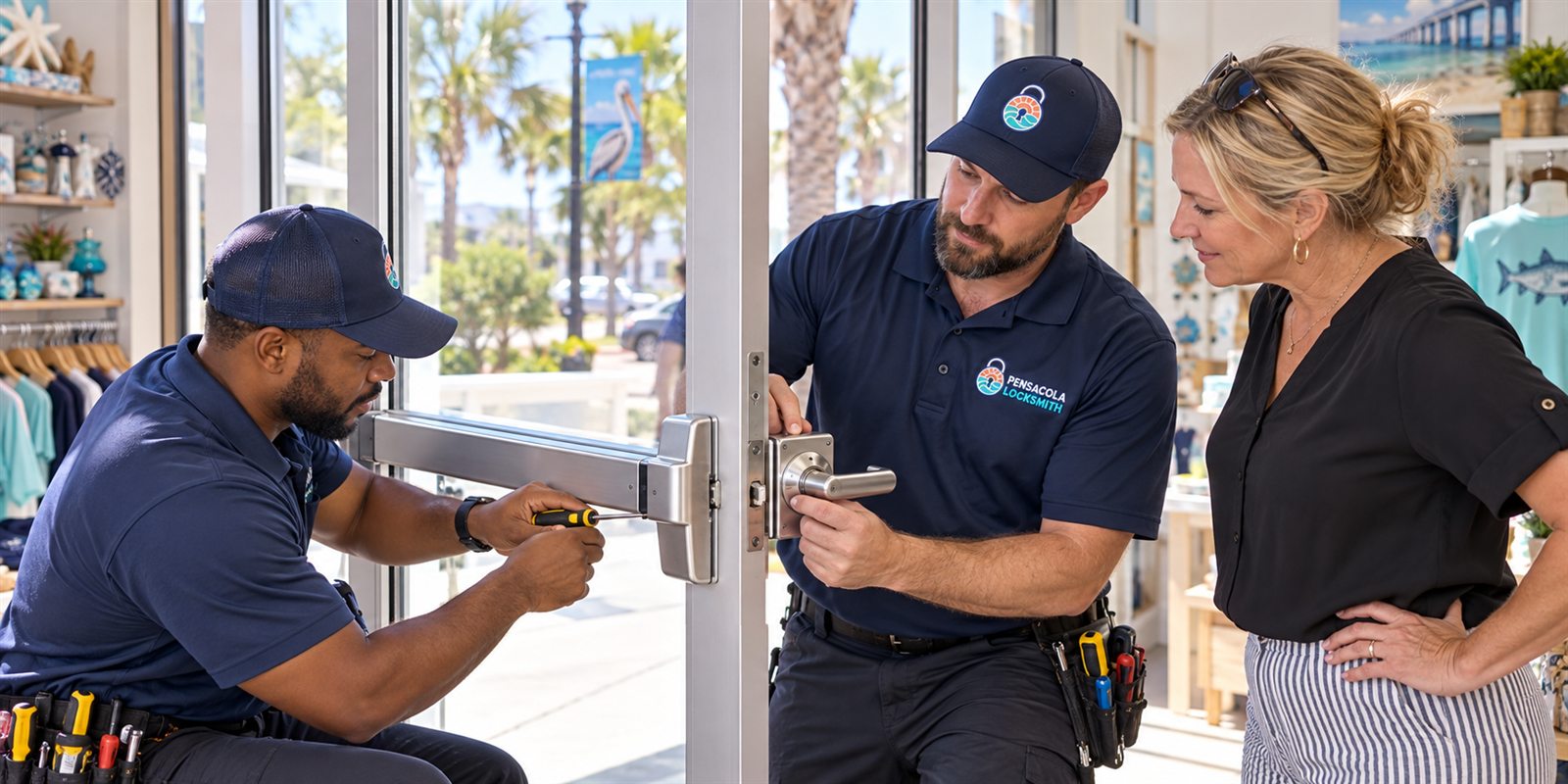
How rekeying works at the door
Inside a standard lock cylinder is a set of small pins at different heights. The key lifts each pin to the right level, letting the cylinder turn. To rekey, the technician removes the cylinder, takes out the old pins, and installs new ones sized for a different key. The outside looks identical, but the old key no longer works.
The process usually takes a short time per lock. The technician removes the cylinder or lock body, disassembles it on a work surface, replaces the pins and springs as needed, and reassembles it. Then they test the new keys, and test the lock on the door a few times to make sure the bolt moves smoothly and engages the strike properly.
Rekeying works best on locks in good condition. If a lock is worn, corroded or damaged, replacement may be wiser. A technician will tell you honestly which is which. Some commercial locks use interchangeable cores that can be swapped quickly with a control key, which makes future changes easier. Describe your hardware when you call and we can advise.
Retail shops have a different pattern. Stockrooms, cash offices, display cases and roll-down gates need protection, and the staff who open and close are often not the people with the highest responsibility. Rekeying lets you separate opening duties from access to the cash office, which gives you finer control over who can reach what.
Planning around opening hours and service
Nobody wants locks changed in the middle of a dinner rush. Plan the work for a quiet part of the day, before opening or after closing, or on a day when you are closed. Tell the dispatcher the hours of operation and which doors are in constant use, so the technician can work around them. Please call to confirm availability for the time you have in mind.
Decide the order of doors. Start with the ones that matter most, such as the cash office and the back door, then move on to the front, storage rooms and any gates. If the work will take a while, ask whether the technician can secure each door before moving on so the building is never left open.
Be on site, or send someone with authority. The technician needs to confirm who you are and that you may authorize the work. They will give you the new keys directly, and you should count and label them before the technician leaves. Avoid leaving keys in unattended spots like a back counter or a mailbox, which defeats the purpose.
Think about how the lock sits in the door. Some commercial doors use mortise locks, others use cylindrical locks or rim cylinders on exit devices. Each can usually be rekeyed, but the process and parts differ. A technician will identify the type, check that it moves smoothly and note any wear that may call for replacement instead.
Which doors to include
It is tempting to rekey just the front door, but a restaurant or shop has many entry points. Think through the whole building: front entry, rear and delivery doors, side doors, roll-up gates, storage rooms, offices, cash or safe rooms, walk-in coolers with locks, cabinets, drawers, and any padlocks on outdoor areas or dumpster enclosures.
Decide whether you want these locks keyed alike or separately. Keyed alike means one key opens several doors, which is convenient for managers. Keyed differently allows more precise control, such as giving a delivery receiver access to the back door only. Many businesses use a combination, with a manager key that opens everything and staff keys for specific doors.
Do not forget the doors that are rarely used. Emergency exits may have locks that are kept closed on the inside but still have a keyed side. Old keys from those doors can end up in forgotten places. If a door is no longer used, consider whether it should be secured or removed from service entirely.
Business owners often ask how many keys to cut. Fewer is better. Start by counting who truly needs access every day, then add a controlled spare for emergencies. If you cut extras for convenience, they tend to wander. It is easier to cut another key later after a conversation than to recover one that has left the building.
Fire safety and legal considerations
Exit doors have rules that exist for good reasons. In general, people inside the building must be able to leave quickly without special knowledge or keys. Locks that need a key to open from the inside can create serious hazards, and local fire officials care about this. A locksmith can discuss hardware, but your fire marshal and landlord set the rules.
If you are not sure whether a lock meets requirements, ask the fire department or your local code office before making changes. Keep paths clear and do not block exit doors with stock or chains. When we rekey, we work within the existing hardware and do not alter exit function without your approval and the proper authorization.
Leased premises add another layer. Your landlord may need to approve changes and may require a copy of the key. Read your lease and talk to the property manager before you start. We check ownership or authority before rekeying, and a short email or letter from the landlord often settles any question.
Think about alarm integration. If your alarm system has user codes, rekeying does not change them, so you must handle those separately. Update the codes when you update the keys, and remove old users from the panel. Combining both steps closes the gap that a rekey alone would leave open.

After the work: new keys and a clean log
Once the locks have been rekeyed, count the new keys and label each one with a code that matches your log. Do not write the business name or the door name on the key. Store spares in a locked cabinet. Make a short list of who receives which key and have each person sign for it, with the date.
Collect all the old keys you can find. They no longer open the rekeyed locks, but they are clutter that can confuse staff, and some may still fit other doors. If you know of former staff who might have old keys, you do not need to chase them, since the keys will not work. That is the point of rekeying.
Tell your team what changed and why, in a calm and neutral way. Explain that it is routine good practice and not a response to any one person. Remind everyone of the rules on copying and loss. A fresh start is the best time to establish habits that keep the new keys under control.
A notice to staff does not need to be dramatic. Something like we are updating all door keys this week, please return your old keys and collect a new one is enough. Most employees will take it in stride. The people who ask many questions about it are not necessarily guilty, but keep a note of how the process goes.
Keeping control over time
Rekeying solves today problem. To keep it solved, you need a process. Keep a log of keys, review it regularly, and make key return part of every departure. A policy that no employee copies keys, together with a restricted keyway for sensitive doors, makes it harder for the situation to drift again.
Consider a master key system if your building has many doors and several tiers of access. A master system lets managers open everything with one key, while staff keys open only their areas. It also makes future rekeying simpler. Our separate guide on master key planning explains the questions to ask before you decide.
Review the situation each season. Restaurants and shops near the beaches often hire and release staff on a cycle, and each cycle is an opportunity to check keys. Put a reminder in your calendar twice a year. A short walk through the building, a count of keys and a look at the log is a small habit that pays off.
After rekeying, tidy your records and store the master list in two places. Keep a copy in your office, locked away, and another off-site or in a secure digital file. If the building suffers damage from a storm or fire, you still have the information needed to replace keys and understand who had access.
Getting a quote and what to prepare
When you call, tell us the type of business, the number of doors, whether they are wood, metal or glass, and what kind of locks you have, including brand if visible. Mention whether you need keyed-alike sets or separate keys, and whether any locks are damaged. Quotes are given by phone, based on what you describe.
If the job is complicated, for example many doors, unusual hardware or damaged frames, a technician visits and the service call charge is explained before dispatch. Please call to confirm availability for your preferred time. Have your ownership or lease information ready, because we check ownership or authority before rekeying or programming.
Make a short list of staff and roles that will need keys, so the technician can cut the right number. After the work, test each key at each door. If something sticks or feels wrong, tell the technician before they leave. A careful finish makes the new system trustworthy from the first day.
A short checklist for the day of the work
Before the technician arrives, gather the keys you currently have and list every door you want rekeyed. Clear the area around each lock so the technician has space. Tell staff who will be present and who is authorized to approve the work. If any doors are hard to reach, such as a locked storage room, make sure someone can open them in advance.
During the work, ask questions. A good technician will explain what they are doing and why. Check that each lock operates smoothly with the new keys, and test the doors from the inside as well as the outside. If an exit device is involved, confirm that it still opens freely from the inside, as it should.
When the job is done, count the keys, sign for them and label them according to your log. Store spares securely. Remind staff of the new rules, and keep the old keys in one place until you are sure all doors work. Call us if anything feels wrong afterward. We check ownership or authority before rekeying, and quotes are given by phone.
Common questions
Is rekeying cheaper or better than replacing locks?
Rekeying is usually the lighter option when locks are in good shape, because the hardware stays and only the internal pins change. Replacement makes sense for worn, damaged or weak locks. Describe your doors when you call and we can quote by phone and recommend the better path for your building.
Will rekeying disrupt my business hours?
It does not need to. Work can be planned for quiet hours or while closed, and doors are handled one at a time. Tell us your schedule when you call, and please confirm availability for the time you want. We can talk through the order of doors so the building stays secure.
Do I need to be there during the work?
You or someone with authority should be present. We check ownership or authority before rekeying, and you will receive and count the new keys directly. If you cannot attend, call us first and we can explain what documentation or confirmation will work.
Can all my doors use the same key?
Yes, locks can be keyed alike, so one key opens several doors. This is convenient but concentrates access in one key. Many businesses mix approaches, with manager keys that open everything and staff keys for limited doors. Call us to talk through what suits your layout and staff.
What if my landlord controls the locks?
Check your lease and speak to the property manager before any work. Some landlords require approval or a copy of the key. We check ownership or authority first, so a short note from the landlord can help. A phone call to us beforehand can clarify what is needed.