
Content note: this page was written by Claude (AI) for Pensacola Locksmith.
How a power door lock is built
A modern car door lock is a small system rather than a single part. There is a latch at the edge of the door that catches the striker on the car body. There is a set of rods or cables that connect the latch to the inside handle, the outside handle and the lock button. And there is usually an electric actuator, a small motor with gears, that moves the lock mechanism when you press the button or the fob.
When you press unlock, the car sends power to that actuator, which turns a gear or pushes a lever. That motion moves a linkage inside the latch, and the latch releases so the handle can open the door. If any part of that chain fails, the lock behaves strangely. The key cylinder on the outside, when present, is another way into the same mechanism, usually by a rod or lever.
Because there are so many connected parts, a stuck lock can mean several things. The actuator motor may have died, the gears may be stripped, a rod may have popped off its clip, or the latch itself may be corroded. Figuring out which one is the cause is the first job of any repair, and it often takes removing the door panel to see inside.
Common symptoms and what they suggest
If you hear a buzzing or whirring sound from the door when you press the button but the lock does not move, the actuator motor is probably working while its gears or connection to the latch have failed. If you hear nothing at all, there may be an electrical issue: a blown fuse, a broken wire in the door jamb, or a dead actuator. Listening carefully to what the door does is a useful first step.
If the lock works from the inside but not with the key outside, the cylinder or the rod connecting it to the latch may be the problem. If it works with the fob but not with the key, the same applies. If only one door fails while others work normally, the fault is likely local to that door rather than in the car's main wiring or the fob.
If the lock works sometimes and fails at other times, think about heat, moisture and vibration. Intermittent faults are often a worn actuator contact or a wire that cracks as the door opens and closes. Doors that stick more in humid weather may have corrosion in the latch. Being specific when you describe the symptoms helps a technician decide where to look first.
The actuator: the most frequent failure
The door lock actuator is a small, inexpensive-looking part that does a lot of work. It cycles every time the car is locked or unlocked, which may be dozens of times a week. Over many cycles, the plastic gears wear and the motor brushes lose contact. Eventually it slows, becomes noisy, or stops. This is the single most common reason for a power lock failing on a car that is otherwise healthy.
Replacing an actuator involves taking off the interior door panel, peeling back the weather barrier, unclipping rods, and removing the latch assembly, because the actuator is usually built into or attached to it. It is detailed work, with many small clips that break if handled roughly. The new actuator must be connected to the same rods and the wiring plugged back in, and then everything is tested before the panel goes back.
Sometimes a repair is possible without replacing the entire latch. In other vehicles the actuator is part of the latch assembly and must be replaced together. A technician can tell you which applies to your vehicle once the panel is off. If the job requires a part that is not available right away, they will explain what that means for timing.
Linkage, clips and cables
Between the handle, the lock button and the latch run thin metal rods or flexible cables, held by small plastic clips. These clips become brittle with heat and age. When one breaks, a rod simply slips off its connection and the handle or lock button moves freely without doing anything. Owners describe this as a handle that feels loose or a button that moves but has no effect.
This failure is common in older cars and in cars exposed to strong Gulf Coast sun. The interior of a door can get very hot, which dries and cracks plastic. Fortunately, the repair is often simple. The technician reattaches the rod with a new clip, adjusts it, and checks the action. It requires access to the inside of the door, but not necessarily a new part beyond the clip.
A stiff or sticky door handle that must be pulled twice to open is another sign. It often means the linkage is bending, the latch is dragging, or a spring has weakened. These are worth attending to early. A handle that is forced repeatedly can break a rod or clip, turning a small adjustment into a larger repair, and it can leave you unable to open the door from either side.
Latch corrosion and wear
The latch itself is a mechanical assembly of springs, pawls and levers. In coastal environments like Pensacola, moisture and salt air can get into it, and old grease dries or washes out. The latch may then stick, fail to release, or fail to catch. A door that will not stay closed, or that does not release even when the handle is pulled, may point to latch trouble.
A technician can often clean and lubricate a latch that is sticky but not damaged, using an appropriate product. This can restore smooth action and is a good first approach when the parts are sound. If the latch is corroded or the metal is worn, replacement is a better choice, since a worn latch can fail unexpectedly and may not hold the door shut securely in an accident.
This is a point where it is wise not to improvise. A latch is a safety component. A door that does not latch properly can open while driving. Do not wrap tape around a latch or wedge it with a screwdriver as a permanent solution. If a door will not latch properly, the car should be repaired before it is driven any distance.
Electrical causes: fuses, wiring and the fob
If several doors fail at once, the cause is probably electrical. A blown fuse in the lock circuit, a failing relay, or a fault in the body control module can stop every door from responding. Check your owner's manual for the fuse location and see whether the lock fuse is intact. A replacement fuse is a safe fix if the old one is blown, though a fuse that blows again points to a deeper fault.
Wires that run through the door jamb are flexed every time the door opens and closes. Over years, those wires fatigue and break inside their insulation. The lock may then work only when the door is held at a certain angle. A technician can inspect the wiring boot, test for continuity, and repair the break, which is a common cause of a lock that works unpredictably.
Do not forget the fob. If the buttons respond only when you are near the car, or intermittently, the fob battery may be weak. If the lock works with the interior button but not the fob, the fob or its programming may be at fault. If the physical key works in the door while the fob does not, the issue lies in the remote side rather than the lock mechanism.

What an owner can safely try
There are a few simple things to try before calling. Lock and unlock several times with the fob and the interior button, listening for sounds. Use the key in the outside cylinder if there is one. Try the other doors. Pull the handle gently while pressing the unlock button, since sometimes the latch needs a bit of help. Be gentle, because forcing a handle can break the rod behind it.
Check the fuse for the lock circuit, and check the fob battery. A cheap test is to try the spare fob if you have one. If the spare works, the first fob is the issue. If neither works, the car side is more likely at fault. These checks cost almost nothing and narrow down the problem before anyone opens the door panel.
Avoid spraying large amounts of lubricant into the door through the gap or the key cylinder. It can run into places it should not and attract dirt. A small amount of a lock-specific product in the keyway is acceptable. Do not try to pry the door panel off without knowing where the clips are, since the clips break easily and cause rattles that are hard to cure.
- Try the fob, the interior button and the key separately
- Check the lock fuse and the fob battery
- Pull the handle gently while pressing unlock
- Do not pry panels or force handles
When the door will not open at all
A door that will not open from outside or inside is a special kind of problem. Often, another door still opens, and you can get in and out through it. If a passenger door is stuck, climb through the driver side. If the driver door is stuck, check whether child safety locks are engaged on the rear doors, which affect the inside handle only.
Child locks are a common surprise. A small switch on the edge of the rear door disables the inside handle so the door can only be opened from outside. If the outside handle also fails because the linkage is broken, the door becomes unusable. Make sure the child lock is off before assuming the worst, since this takes seconds to check.
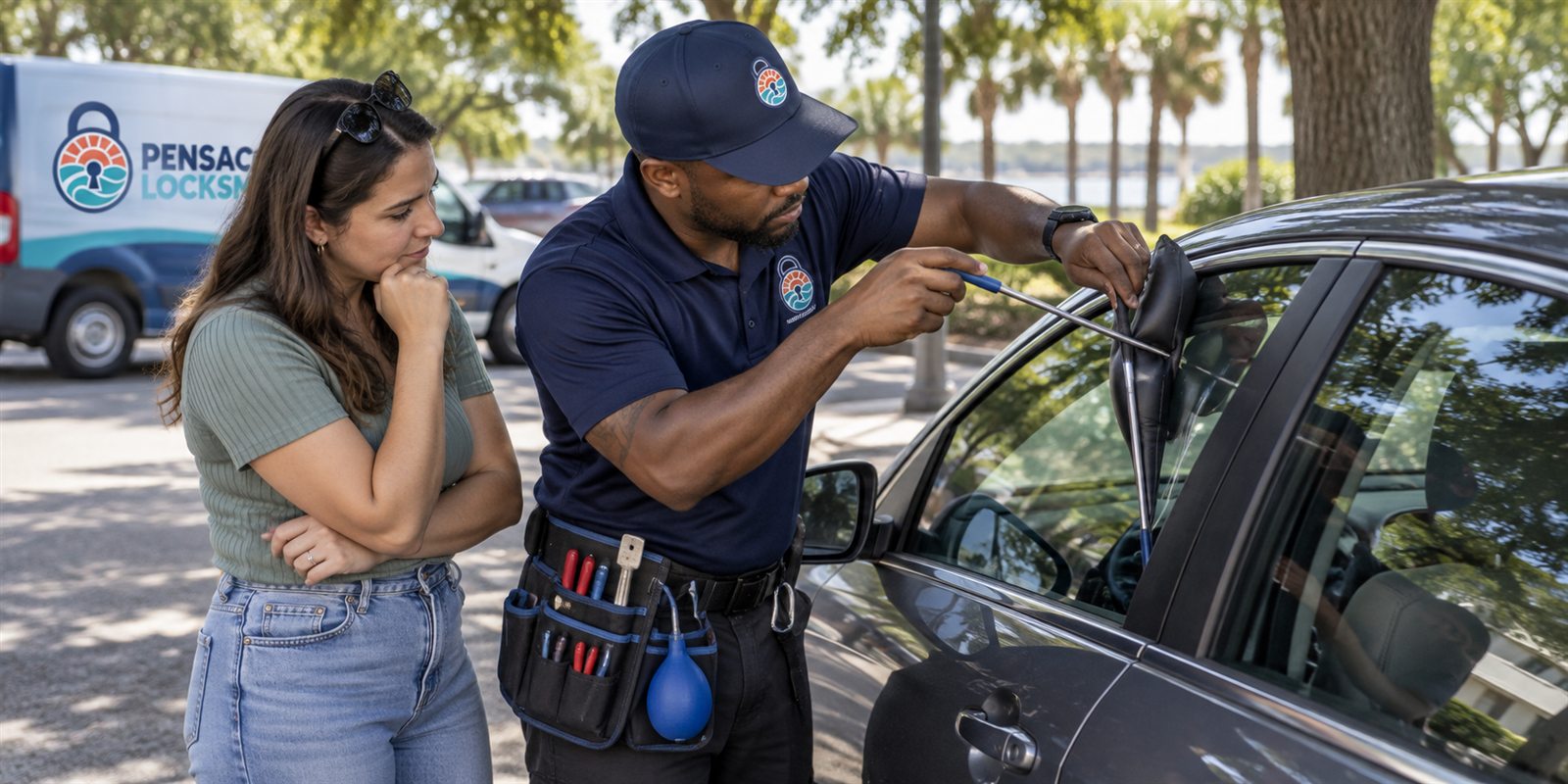
If you are truly locked out because the door will not release and the car is locked, a locksmith can often open it using methods that avoid damage. We confirm ownership first. Once inside, the technician can see whether the problem lies in the latch, linkage or actuator and discuss a repair. Call us and describe exactly what the door does so we can prepare.
What repair involves, step by step
A typical repair starts with diagnosis. The technician tests the lock from each control, listens, and checks the fuse and fob. Next, the interior door panel is removed, which means finding hidden screws, releasing clips and disconnecting the window and speaker wiring. The weather barrier behind the panel is peeled back carefully so it can be resealed afterward, since it keeps water out of the cabin.
With the door open, the technician can see the latch, linkage and actuator. They test the actuator with direct power, check the rods and clips, and examine the wiring. The faulty part is repaired or replaced, then the lock is tested several times before reassembly. Testing before the panel goes back avoids having to open it a second time.
When everything works, the panel and barrier are reinstalled, and the whole lock system is tested with the key, fob and interior controls. A good repair does not leave rattles or loose trim. If the job needs a part that is not on hand, the technician will explain that plainly. Quotes for simple work are given by phone, and complicated work begins with a visit and a service call charge explained before dispatch.
Ownership, security and the keys
Any work on a car's locks involves access to the vehicle, so a locksmith checks ownership before starting. Have the registration or title and a photo ID handy. If the car belongs to a company or a family member, bring authorization. This simple step protects the owner and ensures that lock work is never used to gain access to a vehicle that is not yours.
A stuck lock sometimes reveals a related need. If the key cylinder is badly worn, the key may also be worn. If the car has had a break-in attempt, there may be damage around the handle or cylinder that needs repair. If the fob has stopped working in addition to the lock, programming a replacement might be needed. A technician can address these together rather than in separate visits.
While the door is open, it is a good time to think about security. A car with a damaged lock is easier to enter. Make sure all doors lock fully, that the trunk and any glove box lock operate, and that no valuables are left visible. Call us to confirm availability, and tell us what the lock is doing so we can plan the right tools and parts.
Preventing lock trouble in a humid climate
Cars on the Gulf Coast live in warm, humid, salty air, and door locks feel it. A few habits help. Wash the car regularly to remove salt, and make sure the door jambs and sills are rinsed. Do not let water sit in the door's drain holes, which can clog with debris. Check that the drain holes at the bottom of the door are open, since trapped water corrodes latch parts from below.
Use the lock often enough that it stays in motion. Mechanisms that sit unused for long periods can seize. Operate each door lock, including the key cylinder, occasionally. A small amount of appropriate lock lubricant a couple of times a year helps the cylinder and latch stay smooth. Avoid heavy oil, which attracts dirt.
Pay attention to early warning signs: a slow actuator, a sticky handle, a button that sometimes does nothing. Fixing the problem early is much less disruptive than having a door that will not open at an inconvenient time. If you notice a pattern, call us and describe it, and we will say whether it sounds like a lock issue, an electrical one, or something for a mechanic.
Common questions
Why does my door lock make a noise but not move?
A buzzing or whirring sound with no movement often means the actuator motor is running but its gears are stripped or its connection to the latch has failed. The actuator usually needs replacing, which involves removing the door panel. A technician can confirm after testing.
Is a stuck door lock dangerous to drive with?
It depends. A lock that will not unlock is mostly an inconvenience, but a latch that will not hold the door shut is a safety issue. If the door does not latch securely, have the car repaired before driving any distance.
Could it just be a blown fuse?
Yes, particularly if several doors stop responding at once. Check the lock fuse listed in your owner's manual. If a new fuse blows again, there is a deeper electrical fault and the car should be inspected.
Can a locksmith repair a car door lock actuator?
Often yes, depending on the vehicle and part availability. We confirm ownership first. Quotes for straightforward work are given by phone, and complicated work begins with a technician visit and a service call charge explained before dispatch. Call us to confirm availability.
My rear door will not open from inside. What should I check?
Check whether the child safety lock on the door edge is engaged, since it disables the inside handle. If it is off and the door still will not open, the linkage or latch may be at fault and the door should be inspected.