
Content note: this page was written by Claude (AI) for Pensacola Locksmith.
From plain keys to proximity fobs
The history of keys in a single brand is a quick lesson in how vehicle security has changed. Early keys were simple cut metal, and anyone with a machine could copy them. Later, a chip was added to the head so that the engine would not run without the right code. After that, remotes were folded into the head or placed on a separate fob, and the newest systems let the vehicle sense the fob without any insertion at all.
For you, this means the age and style of your vehicle sets the type of key you need. A key from an older vehicle might be a plain blade with a chip, while a newer one is a flat fob with a push button start. There is no need to memorize details. Look at what you hold and how you start the engine, and tell us on the phone.
A good rule is that the more electronic the key, the more the work involves programming rather than cutting. A plain chip key needs a well cut blade and a short enrollment. A proximity fob needs a compatible transmitter, a registration with the vehicle's computer, and a backup blade. Both tasks are routine for a technician with the right tools.
The flip key, the remote head key and why they differ
Some Buick keys fold the blade into a case, like a pocket knife. You press a button and the blade swings out. This design keeps the key compact and protects the blade, but it adds a hinge and a spring, which can wear. A hinge that sticks or a blade that wobbles is a sign that the key is aging and a spare would be wise.
A remote head key is the more traditional shape. The blade is fixed and the buttons sit on the plastic head. Inside, the head contains the chip and the transmitter. These are sturdy but the rubber pads wear down with use, and the case can crack if dropped. Many owners continue using a worn remote head key long after it looks tired, until a button fails at an inconvenient time.
Either style requires the same two steps. The blade must be cut to match your locks, and the electronics must be taught to the vehicle. If only the case has broken, a technician can sometimes move the internal parts into a new shell. If the electronics are damaged, a fresh key is needed. Ask for an assessment so you can choose between a repair and a replacement.
What the immobilizer is actually doing
The immobilizer is a quiet part of the vehicle that most people never think about. When you turn the key or press the start button, the vehicle asks the key for a coded answer. If the answer is right, the engine receives permission to run. If not, the engine may crank without firing, or it may start and stop within a second or two. Often a small security light on the dashboard flashes.
That behavior is a clue. If a newly made key turns the cylinder but the engine stops quickly, the blade is fine and the code is the problem. A locksmith can then program the key. If the security light flashes even with your original key, something else may be at fault, such as a worn chip, a damaged antenna ring around the ignition or a low vehicle battery that disturbs communication.
Understanding this saves effort. When you describe the symptom, include what the security light does, whether the engine cranks, and whether it happens with every key. A technician uses those details to decide what to bring and what to test. Sometimes the answer is a new key, and sometimes it is a repair to the vehicle that has nothing to do with the key at all.
- Engine cranks but will not stay running
- Security light flashing on the dashboard
- No crank and no response at all
- Works with one key but not the other
Preparing for a locksmith visit
A little preparation makes the visit smoother. Begin with the vehicle identification number, which is visible through the windshield on the driver side or on the door frame label. Write it down or photograph it. The number lets the technician identify the correct key type and any code needed to cut the blade. It also confirms that the vehicle in front of us is the one described in your paperwork.
Next, gather ownership documents. The technician needs to check that you own the vehicle or have authority to act for the owner before opening it, cutting a key or programming one. Identification plus a registration or title is the usual combination. If the vehicle belongs to a business or a family member, mention that when you call so we can explain what is acceptable.
Last, think about access. The technician needs to reach the driver door and to sit inside with a diagnostic tool plugged in under the dashboard. A clear space around the driver side, and a vehicle that is not boxed in by others, helps. If rain is forecast, parking under cover is welcome. Call us with details, and we will confirm availability and explain the process.
The programming session explained
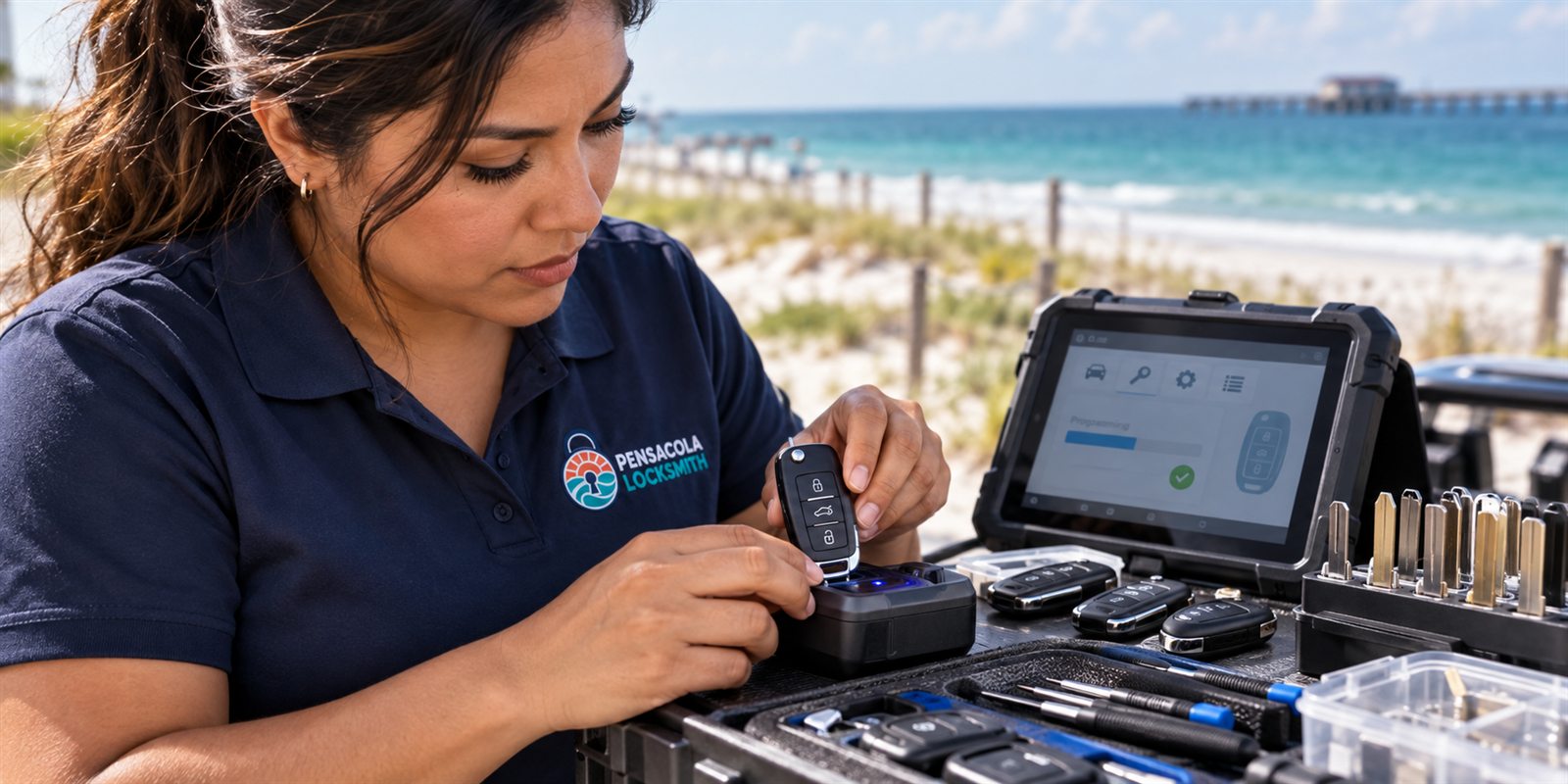
The technician connects a tool to the diagnostic port, which is typically a trapezoid shaped socket under the dashboard near the steering column. The tool identifies the vehicle and tells the technician which programming method it supports. Some methods are quick and require the vehicle to be switched on and off in a certain order. Others need the vehicle to be in a learning state for a set time.
During the session, the technician may ask you to stay close in case a door needs to be opened or closed, a button pressed, or the ignition turned. The new key is introduced to the vehicle, the vehicle stores its code, and the engine is tested. If you have multiple keys, all of them may need to be present, since some systems erase the old list and rebuild it.
Afterwards, the technician checks everything, including starting the engine, using the remote functions and confirming the security light behaves normally. You should see the light turn off a moment after the engine runs. If it keeps flashing, the technician investigates before leaving. A finished job means every key you hold works, and you know what was done.
When a key snaps or the ignition grabs it
A key that breaks in the ignition is an ugly but common event. The blade may snap at the head and leave a piece in the cylinder. Do not try to dig it out with a pin or knife, because that can damage the wafers inside. A technician uses extraction tools designed for this and then cuts a replacement key from the lock pattern, with no need for the broken piece to fit anything.
If the key does not snap but the ignition feels rough, a worn key or a worn cylinder may be the cause. Over many years, the key's teeth lose their edges, and the cylinder's internal parts wear too. A key that was copied from a copy can be slightly off, and the error accumulates. A fresh key cut by code, not copied from the old key, can sometimes restore smooth operation.
If the steering wheel locks and the key will not turn, it is often a simple fix. Turn the wheel gently in one direction while turning the key. That releases the tension on the lock pin. If it still will not turn, stop forcing it. A technician can work out whether the cause is the key, the cylinder or the steering lock, and avoid damage that would turn a small job into a larger one.

Lost keys, stolen keys and clearing the list
If you cannot find your key, first check the obvious places. Many fobs end up in a pocket of clothing in the laundry, under a car seat, or in a bag from a trip. Once you are sure the key is not at home, decide whether it was simply misplaced or might have been taken. That decision affects whether you want the missing key disabled.
Disabling is done during programming. The technician sets the vehicle to recognize only the keys you present. A key that is missing then becomes useless for starting the engine, though its blade might still open the door on some older vehicles unless the locks are also rekeyed. It is a reasonable precaution when a key went missing in a public place.
If the vehicle itself was stolen or broken into and your key vanished, contact the proper authorities first. After that, a locksmith can help restore security to your vehicle. We check ownership before any work, and if the situation is complex, a technician visits and the service call charge is explained before dispatch. Tell us what happened so we can prepare the right tools.
Humidity, salt and the Gulf summer
The air near Pensacola Bay is damp and salty for much of the year, and keys feel it. Metal blades can pick up tarnish, remote buttons can stiffen, and the contacts on circuit boards can corrode. If your fob has been used for years without a battery change, check inside for a white or green crust where the battery sits. That is a sign moisture has been at work.
Heat is the second challenge. A parked vehicle in a Florida summer can reach very high temperatures inside, and plastic cases, adhesives and batteries do not enjoy that. Avoid leaving a fob on the dashboard or in a cup holder in direct sun. Store a spare indoors where it stays cool and dry.
Storm season adds a different concern. During hurricane preparation, many people move vehicles, board up homes and pack quickly. Keys get put in odd places. Decide on one spot for your spare keys and tell the people in your household. If you evacuate, take a spare with you and leave another at home. These habits prevent a calm evacuation from becoming a locked out scramble.
Honest expectations for older and newer vehicles
Older vehicles can be surprisingly tricky. Parts become scarce, key blanks change names, and some early security systems use procedures that are different from modern ones. A technician with experience will know which systems need a timed wait or a special sequence, and will tell you if a particular request is unusual. Do not assume an older vehicle is simpler.
Newer vehicles bring complexity of another kind. Encrypted communication, multiple control modules and strict programming steps mean the technician needs current equipment and access to the right data. Most jobs on newer vehicles are still doable on site, but a few require extra steps or resources. If that applies to you, you will be told plainly, and a technician will visit to assess before charges are applied.
In every case, it helps to be honest about the situation. If the vehicle has been in an accident, has an aftermarket alarm, or has had an earlier attempt at key work, say so. These details change the approach. A locksmith would much rather hear about them at the start than discover them halfway through, when the vehicle is partly disassembled and time is being spent.
Building a sensible set of keys
For most households, two working keys is a reasonable number. One lives in daily use, the other stays at home. If several adults drive the vehicle, a third may be useful. More than that increases the chance one goes missing without anyone noticing, and the vehicle can only remember a limited number of keys. Ask the technician how many your system allows.
Consider a mix of types if your vehicle supports it. A full featured fob for daily use, and a simpler backup that only starts the engine and opens the door. The backup can sit in a drawer without the worry of a battery dying or a button wearing out. Not every vehicle supports every combination, so ask what is available.
Finally, note the date you made each key and check them at least once a year. Press every button, try the blade in the door, and replace the battery if range has shrunk. This small routine catches problems while they are still easy to fix. Call us when you want a spare made, and we will confirm availability and walk you through what is needed.
Door locks, trunk locks and the other cylinders
A vehicle often has more than one lock that the key touches. The driver door is the obvious one, but there may also be a passenger door, a trunk or hatch cylinder, and a glove box lock. On many vehicles these all work from the same cut, but some use a split arrangement where the ignition and the doors follow different patterns. A technician checks each lock rather than assuming.
Worn door cylinders are a common reason for a new key to feel stiff in the door even though it starts the engine perfectly. Years of rain, grit and salty air leave deposits in the lock. A small amount of dry graphite lubricant can help, while oil attracts dust and gums up the wafers. Ask the technician what suits your lock before applying anything.
If a door lock has failed completely, the problem might be the lock cylinder, the linkage behind it or the power lock actuator. A key cannot fix any of those. A technician can often tell by feel whether the cylinder turns freely and whether the latch responds. If the issue lies in the door mechanism, you will be told, so you can decide how to proceed.
Common questions
Can you cut a Buick key without the original?
Yes, in most cases. The blade can be cut from the vehicle's key code or by reading the lock itself, and a chip key is then programmed to the vehicle. Having no original key makes the job longer but it is routine work. Call us with the vehicle details and we will explain how it applies to your key type.
Why does my new key turn but the engine will not stay on?
That usually means the blade fits but the chip has not been taught to the vehicle, so the immobilizer shuts the engine down after a moment. A technician can program the key to the vehicle using diagnostic equipment. Describe what the security light does when you call, since it helps us plan.
Do I need to bring the vehicle to you?
No. Service is mobile, and the technician travels to the vehicle in Pensacola and the surrounding Escambia County area. The vehicle must be present because programming is done through it. Call us to confirm availability. If the job is complicated, a technician visits and the service call charge is explained before dispatch.
What proof of ownership do you accept?
Identification plus a document linking you to the vehicle, such as a registration or title. We check ownership or authority before opening, cutting or programming. If you are acting for a family member or a business, mention that when you call and we will explain what is acceptable in your situation.
Can a broken key be removed from the ignition?
Usually yes. A technician uses extraction tools made for the purpose, then cuts a replacement from the lock pattern. Please do not dig at the piece yourself, because that can damage the internal parts of the cylinder and turn a small job into a larger one. Call us and describe what happened.