
Content note: this page was written by Claude (AI) for Pensacola Locksmith.
A family vehicle and its keys
Many Chrysler vehicles serve as family transport, which means the keys travel through many hands. Parents carry them, teenagers borrow them, children press buttons for fun, and a fob spends time in diaper bags, sports bags and the bottom of a beach tote. That kind of use is hard on keys, and it is common for a fob to be cracked, wet or half worn out by the time it fails.
Because of this, families often benefit from planning their keys, not just replacing them. A spare kept at home, a second fob for the other driver and a plain chip key for the glove compartment of a babysitter's vehicle all have uses. The right mix depends on who drives and how often the vehicle is shared. A short conversation with a technician can help sort it out.
A practical point for households with small children: fobs have panic buttons and remote start buttons that are easy to press by accident. If your fob has been dropped in a bag and the horn goes off unexpectedly, the fob may be worn. Cases wear, buttons stick, and the board inside takes knocks. Describe what has been happening and we can tell you whether it needs repair or replacement.
The ignition key with a chip and the integrated remote
The most familiar key in this group has a metal blade and a plastic head. Inside the head is a transponder chip. When you turn the key, the vehicle reads the chip. If the chip's code is on the approved list, the engine runs. The remote functions may be built into the same head, or they may sit on a separate fob that you carry alongside.
Cutting such a key takes care. The blade profile has to match the ignition cylinder and the door locks, and the cut has to be accurate enough that it does not wear the cylinder prematurely. A rough cut might open the lock but catch on the way out, and a catch can eventually damage the lock's internal parts. A technician cuts with a machine suited to the blade and checks it by testing.
The chip is the other half. Some chips can be copied from an existing key, and others must be created new through the diagnostic port. The method depends on the system. A technician tells you which applies. If a working key exists, the job is often simple. If not, the vehicle needs to be coaxed into learning a first key, and you should expect that to take longer.
Proximity fobs and remote start
Newer vehicles may use a proximity fob. You keep it in a pocket or bag and the vehicle detects it when you approach the door or press the start button. Many of these systems also offer remote start, which warms or cools the cabin before you get in. In Pensacola summers, a cool cabin is a real convenience, and owners tend to rely on the feature heavily.
Remote start adds a layer of security logic. The vehicle runs the engine without a key in the cabin, so it must stay locked and the engine must shut down if someone tries to drive away. For that reason, remote start functions are tied to the fob's identity. A replacement fob has to be enrolled for those functions to work, and sometimes a separate step is required for remote start.
If your replacement fob unlocks the doors and starts the engine from the dashboard but does not run remote start, tell the technician. It might be a missing programming step, or the fob family might not support the feature. We test every function before leaving, including remote start where applicable, and tell you honestly if something in the set is not available for your system.
- Lock, unlock and panic
- Remote start and stop
- Rear hatch or sliding door controls
- Push button start in the cabin
Power doors, hatches and the buttons people forget
Some Chrysler vehicles have power sliding doors or a power rear hatch, and the fob often controls them. These buttons are used less than lock and unlock, so owners may not notice when they stop working. If your fob opens the doors but not the power slider, it may be a worn button, a weak battery or an incomplete enrollment.
Before blaming the fob, check the vehicle. Power doors usually have a switch on the door or dashboard that disables them, and children sometimes press it. If the switch is on and the door still ignores the fob, the issue is either the fob or a vehicle fault. A technician can test the fob with a tool that detects the transmitted signal and shows whether the button is sending.
If the fob is sending and the door still does not respond, the cause lies in the vehicle, not the key. Door motors and sensors can wear or collect debris. You will be told that plainly so you do not buy another fob unnecessarily. A fob that tests well deserves your trust, and you can then take the vehicle to the right repair provider for the door.
What we ask on the phone, and why
We start with the basics: what the key looks like, how you start the vehicle, and what is wrong. The answers let us decide what a technician should bring. A person with a worn but working key needs a different plan from someone who has lost everything. We also ask where the vehicle is, so the technician can plan travel and think about access.
Next, we mention ownership. A technician will ask to see identification and a document tying you to the vehicle, such as a registration or title, before opening the vehicle, cutting a key or programming one. If the vehicle belongs to a company or to a relative, we ask you to say so, and we explain what authority documents might be acceptable.
Finally, we talk about price and process. Quotes are given by phone. If your situation is complicated, perhaps because of a previous failed attempt, an unusual system or a vehicle that is hard to reach, a technician visits first and the service call charge is explained before dispatch. You are never expected to guess. Call us to describe the situation and to confirm availability.
Working through the programming steps
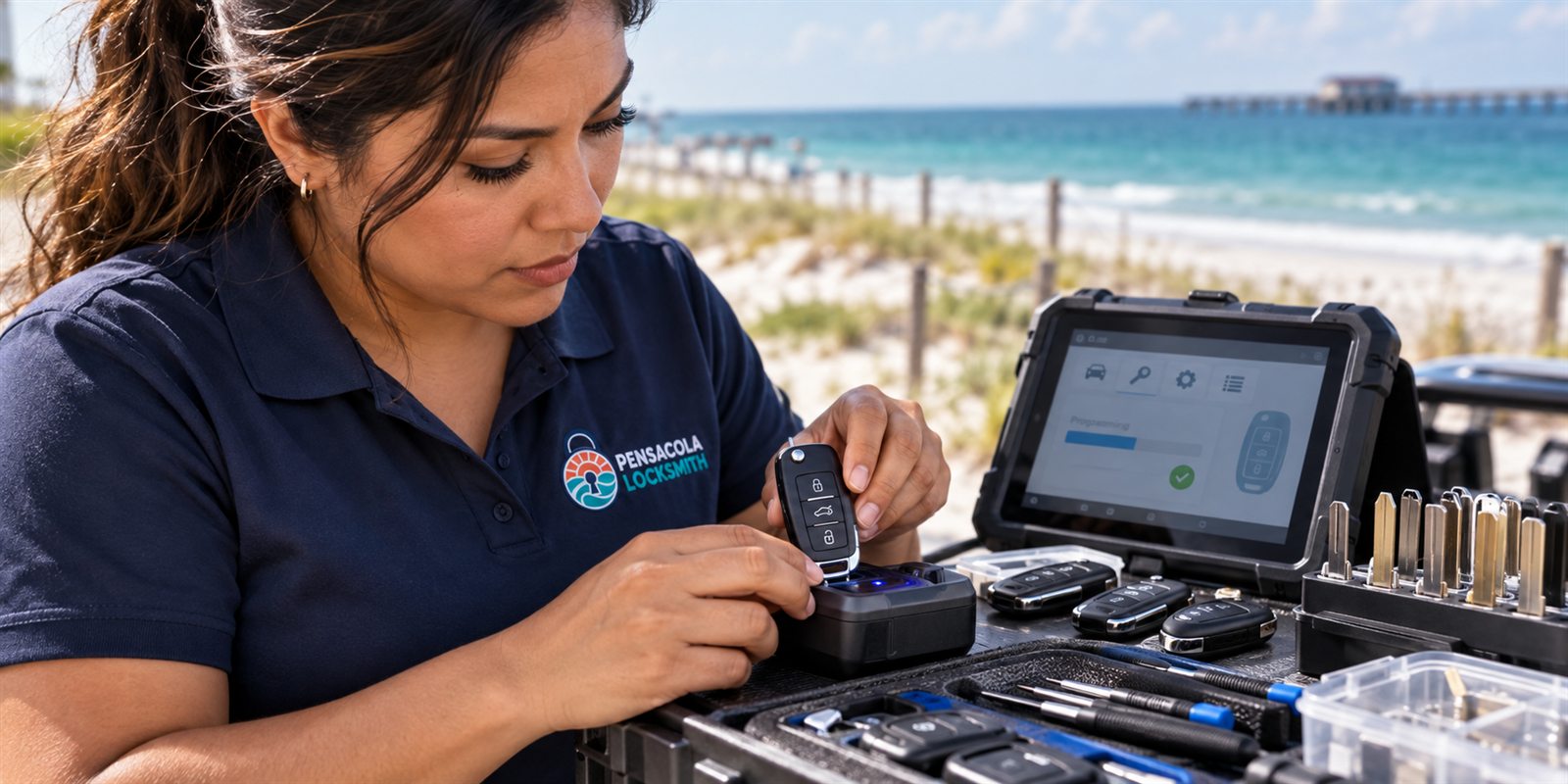
On arrival, the technician verifies the details and reads the vehicle identification number. The key system is confirmed, and a blade is cut if needed. The blade is tested in the door and the ignition. A new fob is checked for basic function before anything is written to the vehicle. This prevents wasted effort on a part that cannot be used.
The diagnostic tool is then connected. For some Chrysler systems, the vehicle requires a security code or a handshake before it will accept a new key. The tool negotiates this. The technician then adds the new key, and the vehicle stores its identity. If an existing key is available, the process may ask for it to be present at certain moments. If not, an alternate method applies.
After programming, the technician tests every function. The engine must start and run steadily. The remote buttons must respond. Proximity detection must work on each door. If a second key is being made, it goes through the same checks. Finally, you are told how many keys the vehicle recognizes. If a key from the past was removed, you are told that too.
Lost keys, borrowed keys and the question of security
When a key is lost, the first question is whether it is simply misplaced or could be in someone else's hands. A key lost in the house is a nuisance. A key lost at a crowded beach or a parking lot is a different matter, especially if the fob was with something that shows your address. In the second case, you may want the old key disabled.
Disabling is a normal part of programming. During the session, the technician tells the vehicle to recognize only the keys you present. Any key not re-enrolled loses the ability to start the engine. On older vehicles, the door locks may still respond to a blade, so if a plain key was taken and you worry about entry, ask about rekeying the locks as well.
If a key was borrowed and not returned, perhaps by an ex-partner or a former roommate, you have the same options. Clearing the old key is a precaution that costs little effort compared with the risk. We still verify that you are the owner or authorized before doing so. If ownership is disputed, we may be unable to proceed, and we will tell you plainly.
Heat, humidity and the Gulf environment
The Gulf Coast climate is hard on plastic and rubber. Heat dries and cracks fob cases, humidity lifts the coating on buttons, and salt leaves deposits on metal contacts. A fob that sits on a hot dashboard for a summer can warp enough that the case no longer closes tightly, letting more moisture in. Keep fobs out of direct sun whenever you can.
Rain and spray are the other hazards. A fob in a pocket during a sudden downpour or a boat trip may get wet. Dry it as soon as possible. Open the case if you can, remove the battery, and let it air out. Do not use a hair dryer on high heat, which can damage the board. If the fob misbehaves later, a technician can inspect it for corrosion.
Hurricane season requires some foresight. If you need to leave quickly, keep a spare key with your emergency supplies in a waterproof container. Store another at home on a high shelf. If the vehicle is moved by a neighbor or a tow service after a storm, you will want to know every key is accounted for. Call us when you want to plan spares ahead of the season.
Fleet, work and shared vehicles
Small businesses in the area use Chrysler vehicles for deliveries, rentals and service calls. Shared vehicles collect keys. An employee leaves, a spare goes missing, and nobody is certain who has what. If a vehicle is used for work, keep a log of keys and who holds them. When someone leaves, collect the key and consider whether an extra copy might exist.
For vacation rental owners, guests may be given vehicles or golf carts along with a house, and keys are a recurring headache. Consider simple chip keys without remotes for such uses, since they cost less effort to replace. Keep your main fobs separate and never leave a full featured fob in a guest welcome box.
Business ownership documents matter in programming. If the registration is in a company name, bring a letter or a document showing your authority to act for the company. The technician needs to check that before work begins. Telling us when you call lets us explain what to prepare. Call us, and we will confirm availability and walk you through what a business vehicle job involves.
Small signs your key is near the end
Keys usually give warnings before they fail. Buttons that need extra pressure, a lock button that works only at close range, a worn spot on the blade, a hinge that wobbles, a case that creaks when you squeeze it. Each is a hint that a spare would be a sensible purchase of time and effort. Do not wait for a failure at the worst moment.
The ignition also shows signs. If you must jiggle the key to get it in, or the key turns only after wiggling, either the key or the cylinder is worn. Replacing the key sometimes helps, and sometimes the cylinder needs attention. A technician can compare a fresh key to the old one and tell you where the wear sits.
Pay attention to the dashboard. A key related warning that appears occasionally, then disappears, usually means a weak battery or a failing contact. Treat it as a hint. Replace the battery, clean the fob gently and see whether the message returns. If it keeps coming back, call us and describe the pattern. Early attention is almost always simpler than a roadside emergency.
Locked out with the engine running or the fob inside
One of the most common calls involves a fob left inside the vehicle. On proximity systems, many vehicles refuse to lock the doors when they sense a fob inside, but not all, and a door shut with the fob on the seat can leave you outside. A technician opens the door with a tool designed not to scratch the paint or bend the weatherstripping, and no key work is needed at all.
Please do not use a coat hanger or a wedge from a toolbox. Modern doors contain wiring, airbag sensors and tight linkages, and prying can cause damage that costs far more than a visit. If a child or pet is inside, or the cabin is hot, call emergency services first. Safety comes before the vehicle, and that is the right order.
Once the door is open, the technician confirms ownership, as always. If the fob was locked inside, you are done after that. If the fob was lost, the key work proceeds. Having a spare fob kept at home or with a trusted person turns this event into a small annoyance. Ask about making one the next time a technician is with you.
Common questions
Can you program a replacement Chrysler fob on site?
In most cases, yes. A technician comes to the vehicle in Pensacola or the surrounding area, confirms ownership, identifies the key system and programs the fob using diagnostic equipment. Remote start and power door buttons are tested too. Call us with the vehicle details and we will confirm availability.
My new fob unlocks the doors but remote start does not work. Why?
Remote start may need a separate enrollment step, or the fob family may not support it on your vehicle. A technician can test the signal and check the programming. Mention remote start when you call so it is planned as part of the job and tested before the technician leaves.
What if a former partner or employee still has a key?
Ask for the older keys to be removed from the vehicle's memory during programming. Only the keys you present will start the engine afterward. We check ownership or authority first. If locks might also matter, ask about rekeying. Describe the situation when you call and we will explain what is possible.
Do you work with business or shared vehicles?
Yes. We need to confirm that you have authority to act for the business, such as a registration in the company name or a letter showing your role. Tell us when you call and we will explain what to prepare. If the job is complicated, a technician visits and the service call charge is explained before dispatch.
Should I worry if my fob has water damage?
Take the battery out, let the fob dry in open air and avoid heat. If it still misbehaves after a day, a technician can inspect it for corrosion and tell you whether repair or replacement makes sense. Salt air near the Gulf makes this a fairly common issue, so mention it when you call.